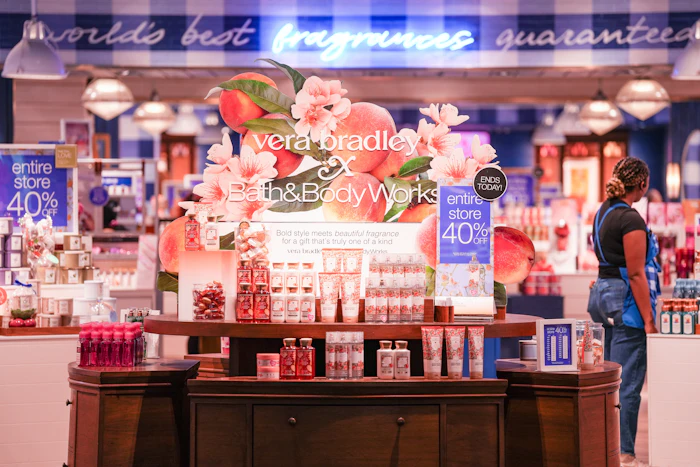
Bath & Body Works’ Q2 2026 results show a business increasingly dependent on channels beyond its traditional store network. U.S. and Canadian store sales fell 5.4%, while direct sales increased 3.0% and international and other sales jumped 24.9%. Total company sales were still down 2.3%, even as the channel mix is shifting, with Amazon and Ulta Beauty increasingly important to that equation.
That said, Bath & Body Works’ stores are proving far more resilient than its sales decline might suggest. Placer.ai found that quarterly visits fell just 0.2% year over year in Q2 2026, indicating that the brand largely held onto the traffic gains it made previously even as consumers faced higher gas prices and broader economic uncertainty. The important distinction is that traffic is holding while sales remain under pressure: consumers are still coming into stores, but that footfall has not yet translated into enough spending to reverse the company’s declining store sales. Placer.ai sees the stability as an early sign that Bath & Body Works’ “Consumer First Formula” is gaining traction, but the data also suggests the turnaround challenge is increasingly about converting existing traffic into stronger purchases, rather than simply getting shoppers through the door.
Ulta is particularly significant because it gives Bath & Body Works access to an established beauty-shopping ecosystem rather than requiring consumers to seek out a standalone Bath & Body Works store or website. The brand now has products available through select Ulta stores and Ulta.com, alongside Amazon and its own digital channel. Bath & Body Works management cited “continued momentum across our marketplace partnerships” as one of the quarter’s positive signals.
That relationship also fits neatly with Ulta’s own strategy. Ulta launched its UB Marketplace to broaden its online assortment beyond its traditional retail inventory, and by the end of fiscal 2025 had more than 200 marketplace brands and 5,000 SKUs. Marketplace products are integrated into Ulta’s digital shopping experience, can earn Ulta Rewards points and can be returned to Ulta stores, creating a more integrated proposition than a simple third-party listing.
For Bath & Body Works, the opportunity is to put the brand in front of beauty shoppers who may not be visiting a Bath & Body Works location. That matters as the physical business contracts: the company ended Q2 with 1,937 company-operated U.S. and Canadian stores, even as its digital and partner channels gained traction.
Amazon serves a similar discovery-and-convenience function, giving the brand another way to capture shoppers outside its proprietary ecosystem. Together, Amazon and Ulta represent a meaningful change in the growth strategy: Bath & Body Works is trying to go where the consumer already shops, rather than relying on the consumer to come to Bath & Body Works. Recent analyst commentary has also identified the Amazon and Ulta expansions as important potential growth drivers.
These channels are helping offset weakness rather than yet producing a full turnaround. Bath & Body Works still expects Q3 sales to decline 2.5-5.0%.