Part 2 of this series will appear in the October 2026 edition of Perfumer & Flavorist+.
Natural vanilla is one of the world’s most culturally embedded and economically Maria Galeas, director of regulatory and scientific affairs, KerryCourtesy of Maria Galeas
This article is only available to registered users.
Log In to View the Full Article
Part 2 of this series will appear in the October 2026 edition of Perfumer & Flavorist+.
Natural vanilla is one of the world’s most culturally embedded and economicallyMaria Galeas, director of regulatory and scientific affairs, KerryCourtesy of Maria Galeas
As Gaël Lescornec, executive director of the Sustainable Vanilla Initiative (SVI), has described, vanilla is “the Mount Everest of supply chains,” not for lack of effort, but because its challenges are deeply rooted in the crop’s biology, geography and institutional context9.
Unlike cocoa, which diversified geographically and developed scalable production systems relatively early, vanilla has remained an artisanal crop reliant on hand pollination, long maturation cycles and smallholder cultivation. Its narrow genetic base and labor-intensive practices have long constrained scalability and resilience6. Despite decades of sustained private-sector investment to stabilize sourcing and improve livelihoods, Madagascar’s vanilla market continues to generate global price shocks driven by tropical cyclones, governance challenges, and policy interventions that periodically disrupt supply. This pattern remains evident in recent history: since 2017, vanilla bean prices have again swung from record highs near US $500 per kilogram to lows around US $20 per kilogram in 2023, following changes in Madagascar’s market structure9,11.
Food manufacturers have largely shielded consumers from these fluctuations through reformulation, long-term contracts and the use of flavor alternatives. Synthetic vanillin, first commercialized in the late nineteenth century, has long served as a substitute for natural vanilla, and more recently, fermentation-derived vanillin has expanded its reach in flavor manufacturing. Today, more than 98% of vanilla-flavored products rely on non-bean sources, while natural vanilla beans account for only 1–2% of total use9.
While this shift has preserved affordability and access, it has also decreased the demand for vanilla beans, the authentic source of natural vanilla flavor as recognized under established U.S. flavor labeling standards, even as agronomic, climatic, and geopolitical risks persist. SVI has emphasized that such periods of turbulence can also function as inflection points for strengthening long-term resilience across the vanilla beans sector11.
 Country-of-origin diversification has therefore become a central pillar of sustainability strategies for vanilla production.chomplearn_2001 at Adobe Stock
Country-of-origin diversification has therefore become a central pillar of sustainability strategies, including the SVI 2030 Charter. The rationale is straightforward: growing vanilla in more places spreads production, mitigates risk and can help stabilize supply. Recent efforts have included investments in emerging origins such as Uganda, with a focus on standardized quality, traceability, and harvest management to reduce overreliance on Madagascar11. However, these initiatives remain constrained by entrenched market expectations that equate vanilla flavor with a single origin and a single default sensory profile, commonly known as the “Bourbon” vanilla profile. Moving past this perception is necessary to build long-term resilience9.
Geographic diversification alone, however, does not fully address the structural vulnerabilities of vanilla. The global vanilla supply remains overwhelmingly dependent on a single species, Vanilla planifolia, resulting in a genetic monoculture that amplifies disease vulnerability and narrows the sensory expression of natural vanilla to one dominant chemical signature, vanillin1,2. Future-proofing vanilla therefore requires a broader approach that includes strengthening commercial cultivars for agronomic resilience, expanding production geographies and increasing genetic diversity within cultivated Vanilla. Beyond current active initiatives, there are also opportunities to revisit regions where vanilla was historically sourced and later diminished by a lack of market demand, including parts of the Americas and the United States2,3.
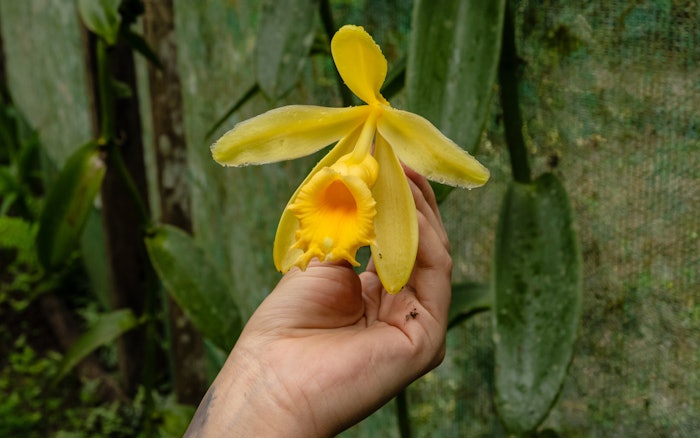
Yet the genus Vanilla is botanically diverse, and one historically significant species, Vanilla pompona, once played a recognized role in American vanilla commerce.
Recent scientific and agronomic research has renewed interest in V. pompona due to its resistance to diseases like Fusarium and tolerance of adverse growing conditions, as well as its distinct aroma chemistry3,10. Comparative aroma studies have shown that anisyl-derived compounds in V. pompona, also found in V. tahitensis, can exhibit equal or greater sensory impact than vanillin within species-specific aroma profiles12. Sensory evaluation of Brazilian V. pompona extracts further demonstrated pronounced vanilla, floral, and fruity attributes with high consumer acceptance across multiple food matrices5. Taken together, these findings challenge the long-standing perception of V. pompona as an inferior-quality vanilla and highlight its potential to enrich and diversify the natural vanilla supply8.
 Sensory evaluation of Brazilian V. pompona extracts further demonstrated pronounced vanilla, floral, and fruity attributes.asife at Adobe Stock
The United States, as the world’s largest importer of vanilla beans and vanilla flavorings, occupies a uniquely influential position in shaping both market expectations and regulatory frameworks. U.S. industry stakeholders have historically played a central role in defining vanilla through commercial practice and engagement with federal regulation4. Recently, U.S. tariff decisions affecting imported vanilla included a temporary pause that reduced immediate cost pressures for the flavor and food industries11.
In addition to ongoing sustainability initiatives in Madagascar, revisiting the U.S. standard of identity for vanilla could support regulatory modernization aligned with increased scientific understanding, including advances in genetics and breeding, analytical chemistry and sensory science. Any changes to the vanilla standard of identity would require formal regulatory review and stakeholder engagement, but such a revision could also restore botanical diversity by allowing additional cultivated species, such as Vanilla pompona, to contribute to long-term supply stability.
Recognizing V. pompona under vanilla flavor definitions would align with broader sustainability goals and echo the SVI’s call for a more resilient supply chain that supports smallholder livelihoods and conserves biodiversity across a wider range of producing regions11. Species-level diversity is also being acknowledged in Codex Alimentarius discussions on international vanilla standards, where V. pompona is recognized as a legitimate source of natural vanilla flavor in its native regions.
In this context, the historical presence of V. pompona in U.S. commerce, particularly prior to 1958, provides a factual basis for regulatory reconsideration grounded in documented common food use. If V. pompona was commonly traded and consumed as “vanilla” before current standards were established, that record can inform safety assessments under common food use and support its reintegration into today’s regulatory framework.
Part 2 examines the documented role of Vanilla pompona in U.S. commerce prior to 1958, as vanilla rose to prominence in American food systems, and explains why this history matters for species-level diversification, regulatory scope, and long-term supply resilience.
References
- Armenta-Montero, S., Menchaca-García, R., Pérez-Silva, A., & Velázquez-Rosas, N. (2022). Changes in the potential distribution of Vanilla planifolia under climate change projections in Mexico. Sustainability, 14(5), 2881.
- Chambers, A. (2025, April 23–25). Growing vanilla in new geographies: Insights from Florida, USA [Conference presentation]. Vanilla Conference 2025, Jersey City, NJ.
- Childers, N. F., & Cibes, H. R. (1948). Vanilla culture in Puerto Rico. USDA Circular No. 803.
- Correll, D.S. (1953). Vanilla: Its Botany, History, Cultivation and Economic Import. Economic Botany (New York Botanical Garden Press), Vol. 7. No. 4, pp-291-358
- Da Silva, F. N., et al. (2023). Chemical characterization and sensory potential of Brazilian vanilla species. Pesquisa Agropecuária Brasileira, 58, e03308.
- Dunphy, P. J., & Bala, K. (2009). Vanilla. In D. Havkin-Frenkel & F. C. Belanger (Eds.), Handbook of Vanilla Science and Technology.
- Galeas, M. (2025, April 23–25). Vanilla pompona Schiede in the U.S. Prior to 1958: A Storied Past, Emerging Opportunities [Conference presentation]. Vanilla Conference 2025, Jersey City, NJ.
- Galeas, M., Lin, J., & Hartman, T. (2015, December). Chemical characterization of Vanilla pompona Schiede, Part I. Perfumer & Flavorist, 40, 16–28
- Lescornec, G. (2025, October 20–22). Securing sustainable vanilla [Conference presentation]. Fall Symposium 2025, Flavor and Extract Manufacturers Association (FEMA).
- Perez-Silva, A., et al. (2021). Quantification of the aromatic potential of ripe fruit of Vanilla planifolia and related species. European Food Research and Technology, 247, 1489–1499.
- Sustainable Vanilla Initiative: 10 Years of Driving Sustainability in Vanilla. Towards a 2030 Charter. 2025
- Tran, T. K. L., et al. (2024). Molecular aroma composition of vanilla beans from different origins. Journal of Agricultural and Food Chemistry, 72, 19120–19130.