Edinburgh whisky has a long and fascinating history. From its early days in Ireland and Scotland, it has evolved from a raw, strong spirit stored in barrels to the rich and complex drink we enjoy today. Early whisky would have been almost unrecognizable to the modern drinker. As barrels were mainly used for storage, rather than aging of whisky. These casks had led full previous lives: hosting products like fish, meat, nails, or other products.
However, over time people noted that wood has memory, and that memory may taste rather good. Today, casks, grain, yeast, and careful distillation, all play a role in shaping each bottle’s character. Moreover, whisky is no longer just for traditional neat-drinking gentlemen. Today it is enjoyed by younger audiences, cocktail lovers and a growing number of women, which shows that this golden spirit truly has something for everyone.
This article is only available to registered users.
Log In to View the Full Article
Edinburgh whisky has a long and fascinating history. From its early days in Ireland and Scotland, it has evolved from a raw, strong spirit stored in barrels to the rich and complex drink we enjoy today. Early whisky would have been almost unrecognizable to the modern drinker. As barrels were mainly used for storage, rather than aging of whisky. These casks had led full previous lives: hosting products like fish, meat, nails, or other products.
However, over time people noted that wood has memory, and that memory may taste rather good. Today, casks, grain, yeast, and careful distillation, all play a role in shaping each bottle’s character. Moreover, whisky is no longer just for traditional neat-drinking gentlemen. Today it is enjoyed by younger audiences, cocktail lovers and a growing number of women, which shows that this golden spirit truly has something for everyone.
This spirit of discovery and innovation set the tone for the 2025 BSF Whisky Symposium in Edinburgh, hosted by Diageo at the fabulous Johnnie Walker Experience venue on Prince Street. Over two days, distillers, flavor experts, scientists and whisky enthusiasts explored the journey of whisky flavor, from barely to barrel to bottle. The event highlighted that whisky isn’t just a drink. It is a journey of craftsmanship, science, and shared passion.
Symposium Day 1
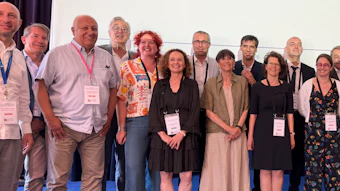
 Day 1 of the symposium included several several lectures and talks on the flavor complexity of whisky.Courtesy of BSF
On the first day of the symposium the presentation session was kicked off by Kristiane Westray, introducing her book Savour – A Guide to Tasting and Exploring Whiskies of the World. She highlighted how whisky drinking has changed: from the traditional neat-drinking gentleman in a leather armchair to a more diverse world where whisky is enjoyed in cocktails by all. The numbers confirm the shift: 30–40% of whisky consumers in the USA and UK are women, and 39% are aged 21–35.
After breaking the barrier of whisky stereotypes, we moved on to its legal framework, discussed by Irene Baxter. These regulations exist to maintain the quality and heritage of the product, protect the consumer from inferior/unsafe products and maintain sensory characteristics. Despite the complexity of flavors found within whiskies, the ingredient list is simple. For scotch whiskies, only cereals, water and yeast are allowed. After maturation for at least 3 years, the bottled whisky needs to contain an alcohol content of a minimum of 40% ABV. All the flavors you might discover from this golden liquid must come from the short ingredient list and processing involved.
No flavorings or sweeteners may be added. However, places like Ireland, Japan and across the Atlantic, will play by different rules. Even though the rulebook might differ where you are in the world, commonalities can be found in the flavor formation. Douglas Murray took the stage to tell us more about flavor development. He described the impact of wooden versus steel wash bags, the copper in the stills, and the influence of ripening time on the recognizability of the spirit’s distillery. Even the curvature of the still, size and location of the curvature influence the degree of vapor chemistry and copper-contact chemistry.
All these flavors found in whisky extend beyond the glass. Karine Kormann from Robertet showed the use of counter current CO2 supercritical fluid extraction to isolate whisky extract aroma. Whisky is rather challenging to work with due to the low aromatic volatile content, but the evidence arrived during our coffee break, when Karine and her colleagues Gaëlle Joyaux and Julie Blanchoin brought us whisky and rum flavored sweets. Peer reviewing at its finest.
After the break Binod Maitin shared how flavor travels through our nose and mouth. Even though hundreds of volatiles can be found in whisky, a great fraction cannot be smelled. Yet some of the marginally present compounds have a great impact on the flavor complexity.
Next, the story travelled to the Annandale-Distillery, where David Thomson introduced us to “Annandale-ness” in their whisky. Their bottles, Man O-Words and Man O-Sword, carry not only great narratives behind their names, but also detailed labels with distillation year, bottling year and bottle numbers to share their individual story for you to grasp.
Next one up was Marco Cardin who shared his work on accelerated whisky aging. Up to 40 years! Not by cheating time, but by understanding it. Here he also focussed on esters, including long chain esters. The latter are often overlooked due to their poor solubility, even though they can bring smoothness and softness to your drink.
Before lunch, the room had travelled from history and law to the whisky distillation processes and its complexity in developing flavors. Yet, to broaden the flavor innovation even further, we need a reliable method to measure the flavor. Which can be complex, as Irene Baxter noted. Some flavor compounds are below the limit of detection of conventional analytical techniques, making our nose, surprisingly, a greater detector. One such compound, 2,4,6-trichloroanisole (TCA), can enter the whisky due to a faulty cask or packaging and flattens the flavor profile. Using descriptive and quantitative sensory analysis, TCA can be identified to avoid the loss of a great drink.
Kami Newton then widened the lens even further by showing the creative side of looking at flavor. He addresses how taste is often overlooked as there is a large focus on odour. Burning, cooling, fizziness and tingling can be also added to the list of sensations when experiencing your whisky. And have you ever considered the turbulence in your nose affecting the flavor?
After these great presentations we still had one job to do: find the best chocolate to pair with some incredible whiskies. Under the guidance of Spencer Hyman from Cocoa Runners we created some great matches of sourdough chocolate with Black Ruby label by Jonnie Walker and 70% Dark chocolate from the Solomons Islands with Lagavulin whisky.
A day full of learning, tasting, and shared passion set the stage perfectly for the Jonnie Walker experience and the evening diner, held at the Scotch Malt Whisky Society.
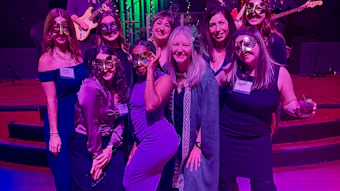
 Members of the British Society of Flavourists were treated to a dinner held by the Scotch Malt Whisky SocietyCourtesy of BSF
Symposium Day 2
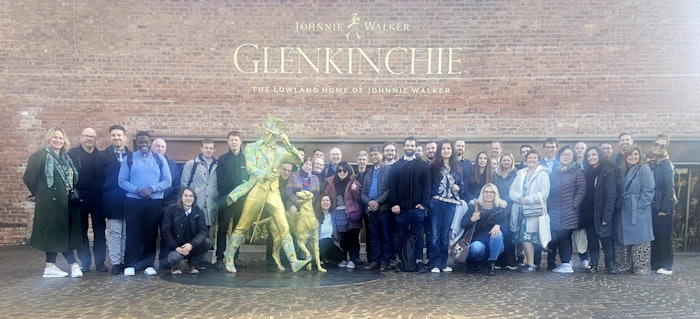
After a day immersed in flavor science, sensory analysis, and spirited discussion, the visit to Glenkinchie Distillery stood out as a highlight of the Whisky Symposium. From a flavorist’s perspective, Glenkinchie offered a clear and confident expression of what Lowland whisky stands for: purity, elegance, and precision.
Whisky production may be complex, but at its heart it follows a clear journey from barley to bottle. Each step offers opportunities to shape flavor, and at Glenkinchie, these decisions are made with remarkable consistency. From the outset, the distillery commits to an unpeated style, staying true to the Lowland tradition. By avoiding peat during kilning, smoky phenolic notes are excluded, allowing lighter, floral, grassy and fruity aromas to shine.
This early decision sets the foundation for Glenkinchie’s house style. The malt’s natural sweetness remains intact, and the focus shifts to freshness and balance rather than intensity. Fermentation further reinforces this approach. With a fermentation time of around three days, the distillery favours the development of grassy and floral esters over heavier tropical fruit notes.
Distillation plays an equally important role. Glenkinchie’s large, tall copper pot stills encourage reflux, helping to refine the spirit and remove heavier compounds. An early tail cut ensures that only the cleanest part of the spirit is collected, resulting in a light, dry new make. This philosophy is often referred to at Glenkinchie as “Purityism”: tight control at every stage to highlight elegance rather than weight.
Maturation takes place mainly in refill ex-bourbon casks. These provide gentle notes of vanilla and cream from American oak without overpowering the spirit’s delicate character. The final whisky expresses crisp green apple, soft sweetness, fresh grass, and floral notes such as honeysuckle.
Fermentation insights added another layer to the visit. Glenkinchie continues to Whisky production may be complex, but at its heart it follows a clear journey from barley to bottle.Heleno at Adobe Stock
We were also introduced to a simple but effective sensory technique: observing the “collar” and “legs” of the spirit in the glass. Faster-forming, finer legs indicate a lighter whisky with lower oil content, offering a quick visual cue to mouthfeel and style.
Beyond the distillery visit, the Whisky Flavor Challenge organized and supported by VCF-Online highlighted the creative side of flavor science. Using a limited number of ingredients (naturally found in specific bottles), participants recreated whisky styles with impressive depth and authenticity. The winning entry by Vanessa Robert of Givaudan showed how balance, warmth, and subtle floral notes can come together in a convincing whisky profile, described by the judges (our speakers) as aged in a rejuvenated cask.
The second day of the symposium beautifully connected theory with practice. Glenkinchie demonstrated how technical precision, sensory understanding, and respect for tradition can result in a whisky of clarity and refinement. A fitting conclusion to a symposium that celebrated whisky not just as a drink, but as a shared craft rooted in science, creativity, and passion.
BSF is now eying at 2026 and heading to Munich to explore the flavorful world of beer; call for speakers is now open and the event will be held on September 16-17th just before the famous Oktoberfest. Potential speakers can apply at [email protected] and shortlisted at the beginning of the new year.