One of the persistent challenges of our work is the number of different ways many chemicals can be named. γ-Butyrolactone (FEMA GRAS #3291, CAS #96-48-0) is not the worst offender, but 4-hydroxy butanoic acid lactone, oxalan-2-one, 1,4-butanolide, 4,5-dihydro 2(3H)-furanone and tetrahydro furan-2-one are all commonly used alternative names. Thankfully, there are no major trade names to add to the confusion.
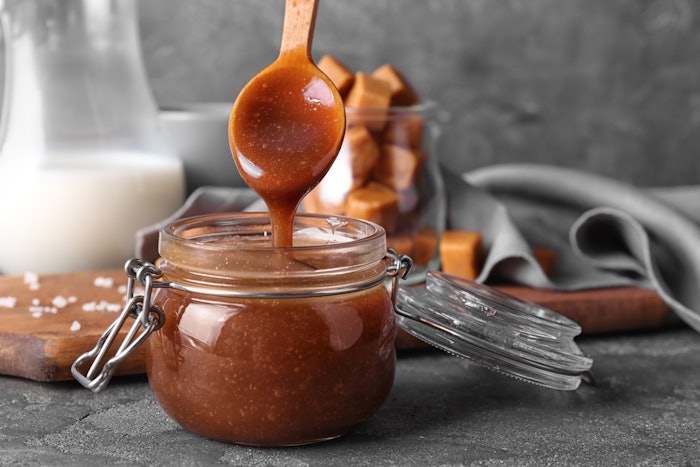
γ-Butyrolactone has a mild, but attractive, caramel note, with a hint of cream. It has an obvious role in brown flavors, but can also play a useful role in very many other flavors. Despite the challenge that it is DEA listed, it is widely used in flavors across the globe.
Note that the dose rates given throughout this article are the levels suggested for use in flavors intended to be dosed at 0.05% in ready-to-drink beverages or in a simple bouillon.
Brown Flavors
Caramel: It is no surprise that one of the highest suggested use levels is in caramel flavors. Three thousand ppm is a good starting level, adding considerably to authenticity.
Chocolate and Cocoa: Levels in these two flavor categories are more moderate, ranging from 300 to 500 ppm.
Coffee: Here we are back to a high suggested level of 3,000 ppm, adding a soft background to all the roasted and burnt notes.
Maple: Levels in maple flavors can vary considerably. More moderate levels, from 200 to 500 ppm, are better in realistic flavors.
Molasses and Brown Sugar: γ-Butyrolactone is found naturally at high levels in brown sugar and this is reflected in a suggested use level between 2,000 and 3,000 ppm in brown sugar and molasses flavors.
Vanilla: In contrast, this raw material plays a modest, but helpful, part in vanilla bean flavors at around 50 ppm.
Savory Flavors
Bacon: Use levels in savory flavors are more often in the middle range. Bacon is a good example, with a suggested use level of 400 ppm.
Beef: All beef flavors gain in authenticity from γ-butyrolactone. Higher levels, around 1,000 ppm, are better in roast type profiles.
Chicken: Chicken flavors also cover a range of levels of addition, but the levels are generally lower, around 100 ppm.
Pork and Ham: Pork and ham flavors also use γ-butyrolactone in a modest supporting role, at levels ranging from 100 to 200 ppm. The addition of γ-butyrolactone can smooth harsh smoke flavors.Studio at Adobe Stock
Smoke: Eight hundred to 1,000 ppm of γ-butyrolactone smooth even the harshest of smoke flavors.
Tomato: This is not really a category of flavors where γ-butyrolactone can be recommended for fresh profiles. However, it works very well in cooked and sun-dried profiles. Five hundred ppm is a good starting point.
Nut Flavors
Cashew Nut: γ-Butyrolactone levels in nut flavors vary considerably. Cashew nut flavors are at the high end, with a recommended level of 2,000 ppm.
Hazelnut: Hazelnut flavors need rather less of this ingredient. Five hundred ppm is more than enough.
Peanut: γ-Butyrolactone adds creamy depth to peanut flavors at 1,000 ppm.
Pistachio and Almond: Some, lightly roasted, flavors benefit from as little as 50 ppm. Alternatively, more aggressive flavors can take up to 800 ppm.
Walnut: Despite their less aggressive profiles, walnut flavors need higher levels of γ-butyrolactone, up to 2,000 ppm.
Fruit Flavors
Apricot and Peach: γ-Butyrolactone might be expected to be found in dried apricot flavors, and it does work well at 1,000 ppm. Much less obviously, it also helps add authenticity to fresh apricot flavors at 100 ppm.
Cherry: Three hundred ppm of this raw material broadens the profile of all styles of cherry flavors.
Grape: γ-Butyrolactone adds realism and complexity to all grape flavors. It works best in Concord grape flavors at 300 ppm.
Prune and Raisin: The somewhat dried character of prune and raisin flavors is notably assisted by γ-butyrolactone. One thousand ppm works well.
 γ-Butyrolactone can be used in both dried and fresh apricot flavors.Olena Rudo at Adobe Stock
Alcoholic Drink Flavors
Beer: γ-Butyrolactone has something to offer in every type of beer flavor. Levels range from a mere hint at 10 ppm in lagers up to 300 ppm in ales.
Rum: Levels in rum flavors also vary dramatically, from around 50 ppm in light rums up to 1,000 ppm in Navy rums.
Sake: Sake flavors can also make good use of this ingredient. Two hundred ppm is a reasonable level of addition.
Whisky: γ-Butyrolactone helps to build the caramel character in all types of whisky flavors, starting at 50 ppm.
Other Flavors
Cereal and Bread: This ingredient is very effective in all cereal and bread flavors at levels from five to 1,500 ppm.
Coconut: It is also successful in coconut flavors at levels from 100 to 400 ppm. Illogically, the higher levels work better in coconut water flavors.
Honey: Honey flavors are often dominated by heavy taste notes, such as phenyl acetic acid, and bright floral notes, such as linalool. Four hundred ppm of γ-butyrolactone helps fill out the middle ground.
Olive: Olive flavors can sometimes end up surprisingly complex, so adding another ingredient might not seem wise. Two hundred ppm of this raw material is worth the risk.
Tea: The contribution of γ-butyrolactone to tea flavors is very closely linked to the type of tea that is the target. Eight hundred ppm for red teas, 500 ppm for black teas, 100 ppm for rooibos teas and, finally, 50 ppm for green teas.