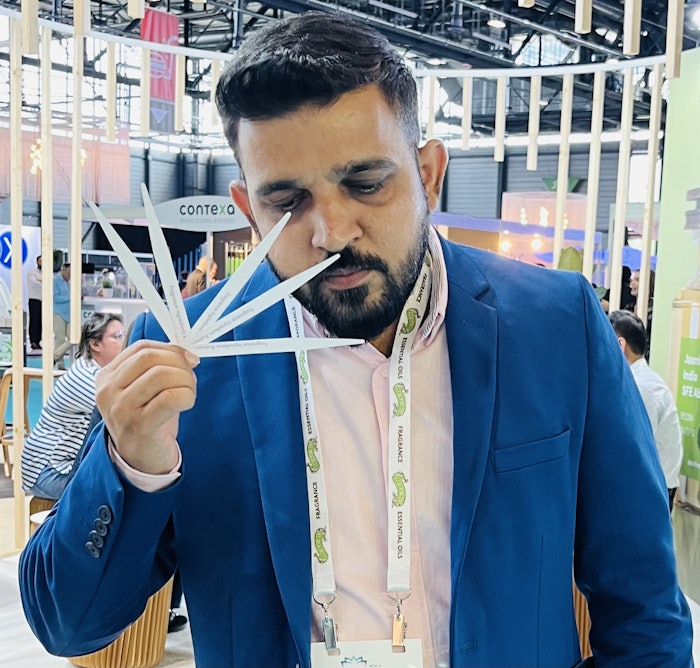
Name: Vishal Deshmukh
Title: Chief Perfumer
Location Amroha, Uttar Pradesh, India
What led you to the fragrance industry?
My journey into the fragrance industry began with a deep fascination for how scents can evoke emotions and memories. I was always intrigued by the connection between chemistry and creativity, how a formula could translate into an experience. This curiosity led me to explore perfumery as a career, where I could combine both science and artistry to create robust novel fragrances that inspire people in their everyday lives.
Can you share a defining moment or breakthrough in your career as a perfumer?
My breakthrough came when I was tasked with developing a fine fragrance inspired by Middle Eastern perfumery. It pushed me out of my comfort zone, working with rich ouds, saffron, musk and amber, and taught me how to merge cultural depth with modern elegance. The result became one of my proudest creations and shaped my olfactive signature as a perfumer.
One of the other key breakthroughs in my career was developing a stable, long-lasting accord that balanced performance and cost without compromising olfactive quality. It taught me the importance of technical precision and creative flexibility in how innovation often comes from problem-solving within constraints.
What were some of the biggest challenges you faced when entering the perfume industry, and how did you overcome them?
One of the biggest challenges when entering the fragrance industry was the limited access to training and mentorship. Perfumery is a niche field where opportunities are few and highly competitive. I overcame this by dedicating myself to self-learning, studying raw materials-natural ingredients and synthetics, analyzing existing market fragrances and constantly practicing formulation. I also sought feedback from experienced professionals whenever possible, which helped me refine both my technique and creative direction.
Can you describe a time when a fragrance formulation didn’t turn out as expected? How did you address the issue?
There was a project where the fragrance I developed for a liquid detergent smelled beautiful in the lab, but once added to the base, it lost its freshness and developed a slightly harsh undertone. After evaluating, I realized some top notes were reacting with the alkaline system. I reformulated the accord by adjusting the balance of citrus materials and replacing a few unstable aldehydes with more stable esters. The improved version performed well both in stability and sensory evaluation.
How do you find the right balance between artistic expression and the technical limitations of perfume formulation?
For me, balancing artistic expression with technical limitations is the essence of perfumery, especially in functional products like detergents. I start by translating the creative idea or mood into an olfactive direction for example, “fresh floral with a clean, lasting base.” Then I adapt that vision to the technical realities of the product base pH, surfactants, dosage, and cost constraints.
The challenge is to maintain the soul of the fragrance while ensuring stability and performance. I often use creative reconstitution, finding alternative materials that capture the same character but can withstand alkaline environments or high temperatures. In this way, creativity becomes more about intelligent adaptation rather than compromise.
I believe true artistry in perfumery lies not just in composing beautiful accords, but in making them work beautifully in their intended application.
Are there specific skills or knowledge areas you believe are crucial for a perfumer to master?
I believe olfactory memory and sensitivity, recognizing and remembering scents, raw material knowledge of natural and synthetic ingredients, chemistry understanding of how ingredients interact and affect stability, blending and formulation, regulatory awareness and creativity and artistic sense innovating unique scents are top skills crucial for a perfumer to master.