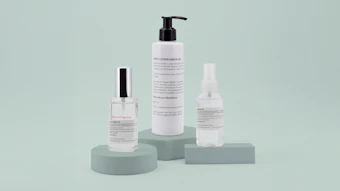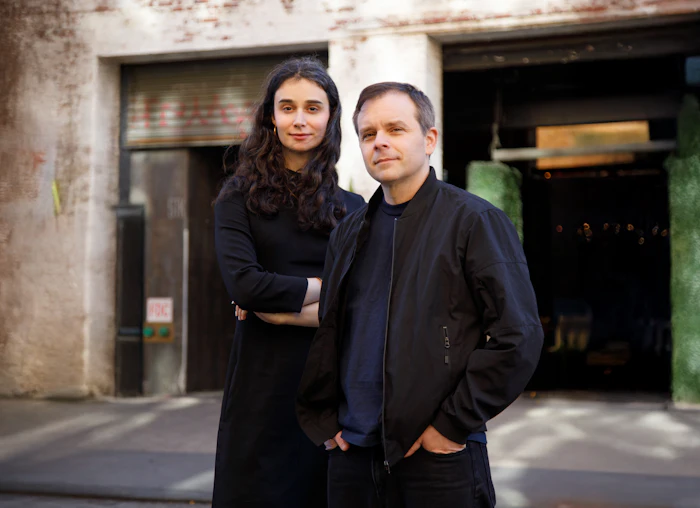
Fragrance tech startup Patina recently raised $2 million from investors including Betaworks and True Ventures to accelerate its effort to reinvent how scents are created, per TechCrunch.
We think on demand scent and flavor (think 3D printing food) is not too far off.
Founded by artist-perfumer Sean Raspet and engineer Laura Sisson, the company is building a machine-learning–driven platform called Sense1 that models how molecules interact with human olfactory receptors. Its goal is to replace today’s language-based system of describing smells (like “floral” or “woody”) with a biological “code of smell” that can precisely represent and predict scent at the molecular level.
Sense1 Pushes AI Fragrance Design Toward a “Pantone for Scent”
Perfumer & Flavorist+ spoke with the founders to learn more about the company and its emerging technology platform.
"Our model, Sense1, is the farthest along on individual molecules compared to docking and existing deep-learning models and it’s improving with each new version," say Raspet and Sisson.
That, they claim, would constitute a "39% improvement over optimized docking baselines."
Raspet and Sisson add, "From this single molecule foundation we are expanding to the combinatorial/formulation level. The next update of Sense1 will have expanded functionality in this layer. We feel that fully solving this challenge will be a breakthrough for the industry because it could create a reference standard for describing, identifying, and protecting fragrance IP."
Patina is aiming to use this approach to design entirely new scent molecules, replicate complex natural materials like rose oil more accurately, and reduce reliance on fragile agricultural supply chains. The company argues that AI-enabled molecular design could also make fragrance creation faster, cheaper, and more customizable, while improving intellectual property protection in an industry where formulas are hard to defend. Backed by early partnerships with fragrance houses and fashion brands, Patina sees its long-term vision as building a “Pantone for scent”—a universal system of primary scent building blocks that can be used to construct any fragrance or flavor on demand.
Patina's core idea is that smell, unlike color or sound, has never had a true digital encoding system. While vision can be represented through RGB and audio through formats like MP3, olfaction has remained largely subjective and language-driven. Patina aims to change this by building the Sense1 computational framework, which models how molecules interact with roughly 400 human olfactory receptors.
[W]ith ~400 mols theoretically, you could design a single precise, highly-selective fragrance molecule for each and every receptor.
Patina treats scent as a biological code: Each molecule activates a specific combination of receptors, producing a distinct activation pattern that corresponds to how a smell is perceived. By mapping these patterns, the company is working toward a universal “scent code” that can represent any odor in a standardized, data-driven way, similar to how RGB represents color. This approach is intended to function as a compression system for smell, enabling consistent representation and prediction of scent at the molecular level.
"[W]ith ~400 mols theoretically, you could design a single precise, highly-selective fragrance molecule for each and every receptor," say Raspet and Sisson. "This would be one way to create the full range of possible scents from a minimum of inputs and would be the basic RGB palette. But on a more practical level, molecules that activate one and only one olfactory receptor are the exception and are difficult to design."
They add, however, "A more likely path (which we are working toward) is a smaller set of extremely well characterized molecules that have known activation levels across all ~400 receptors that can be computationally blended to recreate any scent and any specific olfactory activation pattern. These molecules aren’t 100% selective to only one receptor, but they have been fully modeled and can be blended to achieve precise activation patterns."
Raspet and Sisson continue, "The actual set might be around 150 - 200 molecules, with very complete characterization of olfactory activity, including combinatorial effect, allowing for the complete recreation of the vast majority of scents (and flavors). Molecules with known antagonism are another lever that can be used in fine tuning the set and its operation."
Beyond Prediction to Creation: Targeting Novel Scents and Expanding the Perfumers’ Palette
The company’s ambitions extend beyond modeling. Patina aims to use this system to design entirely new molecules that produce novel scents, including sensory experiences that do not exist in nature.
"Some companies use AI to remix existing ingredients, making faster formulations from the same palette," say Raspet and Sisson. "Our process of olfactory receptor modeling is more targeted. We're working at a different level entirely. Patina models how scent is perceived at the receptor, the biological mechanism itself. That's what makes it possible to discover molecules that have never existed, and to understand why something smells the way it does."
They continue, "We want to expand the perfumers palette, and at the moment we're focused on finding really special new aroma molecules to do that. For example, Silterra is one of our molecules; what we love about it is that it’s built around a silicon atom. This is very unusual and shifts the character of compounds around it toward something earthier and more naturalistic."
There are some kinds of sensory experiences that are currently impossible, or impossible to do safely, and these are our biggest targets for 'never-before-smelled' molecules.
From a perfumer's perspective, novelty is only valuable if it is aesthetically desirable. Perfumer & Flavorist+ asked Raspet and Sisson about how the company evaluates whether a predicted "never-before-smelled" molecule will actually be useful in applications.
They note, "We are a perfumer led company (Sean is a perfumer as well as a flavorist), so for every product line, or every discovery project we begin, we have a sense of which aesthetic profiles are neglected. There are some kinds of sensory experiences that are currently impossible, or impossible to do safely, and these are our biggest targets for 'never-before-smelled' molecules."
The founders also share novel materials with a "community of perfumers" that offers feedback.
They note, "Sense1 is a tool, it helps narrow a path but ultimately the perfumer decides the direction and if something has promise ... "
Unique materials are also encountering a wider audience.
"We’re working with select partners in fashion and film to develop custom scents with Patina molecules," say Raspet and Sisson. "These are incredibly valuable collaborations for us."
The company will also be growing its "community of trusted noses in the coming year."
At the same time, many of the industry's most valuable materials owe their success to performance characteristics such as substantivity, diffusion, stability and formulation compatibility. How does Sense1 address these properties, or is it currently focused solely on odor perception?
"We’re concerned with all of the above," say Raspet and Sisson. "There are existing profiles that we can replicate to be safer, longer lasting, and more stable. Compared to modeling receptor activation, performance characteristics are relatively trivial, and we can use the same statistical techniques."
High-Fidelity Botanical Replication
Beyond novel materials, Patina also seeks to improve the replication of complex natural materials like rose or vanilla, which contain hundreds of chemical components and are difficult to reproduce accurately with current synthetic methods. A key goal is to reduce dependence on fragile or ethically constrained natural supply chains by creating reliable, lab-designed alternatives.
"We’re soft launching a new blend, Rose Hypothetical that arrives at the scent of Bulgarian Rose Otto, through entirely different chemistry."
The company suggests multiple molecular combinations can generate the same receptor activation pattern, allowing a fragrance house recreate a natural extract's olfactory signature without reproducing its exact chemical composition.
"The practical limitation is that you may need precise/selective molecules to achieve this," say Raspet and Sisson. "We’re soft launching a new blend, Rose Hypothetical that arrives at the scent of Bulgarian rose Otto, through entirely different chemistry. It is a high-fidelity 1:1 recreation in olfactory terms, closer to rose essential oil than any other reconstruction. For this we’ve incorporated the proprietary Patina molecule Hyperflor as a floral fixative, giving it a tenacity that rose essential oil alone cannot match."
The founders add, "We have been focusing on rose because the few micro-climates that produce it have already begun to experience disruptions, and the cost/kg enables us to do exploratory work."
The Future: an Operating System for Smell, On-Demand Scent Design and New IP Protection for Fragrance
Looking ahead, Patina's founders note, "We are primarily a molecule discovery company, but as Sense1 evolves we see high-fidelity replications as a place where we can have great impact. As technological discovery continues, we imagine applications expanding as well. We think on demand scent and flavor (think 3D printing food) is not too far off."
"An industry-standard receptor coding system would pave the way for IP protection."
More broadly, Patina envisions a future where scent and flavor can be designed on demand, allowing perfumers and brands to compose fragrances with the same precision as digital media. Because olfactory receptors are found throughout the body—not just in the nose—the company also sees potential for applications beyond fragrance, including skin health and other biological interactions. Ultimately, Patina is positioning itself as building an “operating system for smell,” turning olfaction into a programmable domain grounded in biology, data, and machine learning.
Raspet and Sisson conclude, "We’ll be very happy when we discover and launch some blockbuster captives. But the implications of nailing a compression algorithm for scent, analogous to the RGB system for color, is a huge unlock. Today, any fragrance formula can be reverse engineered, allowing duplication of creative works at an industrial scale. This is a problem for perfumers and brands alike. An industry-standard receptor coding system would pave the way for IP protection. The reason nothing like this exists is that we currently don’t have any technique for objectively representing a scent: without that, there is no accurate system for determining how similar two scents are, and therefore no way to determine infringement."