Established in 1966, The Research Institute for Fragrance Materials (RIFM), a bedrock for fragrance safety, has been publishing safety assessments on thousands of fragrance materials and conducting animal-free research for over a decade. Fragrance safety is built on a well-established scientific framework that has developed over decades of research. One challenge, however, continues to arise in both technical and broader discussions: How should toxicological findings be interpreted in the context of human health and real-life fragrance use?
 Arianna Bartlett, Ph.D., Senior Associate Scientist, Repeated Dose and Reproductive Toxicology, RIFMRIFM
This article is only available to registered users.
Log In to View the Full Article
Established in 1966, The Research Institute for Fragrance Materials (RIFM), a bedrock for fragrance safety, has been publishing safety assessments on thousands of fragrance materials and conducting animal-free research for over a decade. Fragrance safety is built on a well-established scientific framework that has developed over decades of research. One challenge, however, continues to arise in both technical and broader discussions: How should toxicological findings be interpreted in the context of human health and real-life fragrance use?
Arianna Bartlett, Ph.D., Senior Associate Scientist, Repeated Dose and Reproductive Toxicology, RIFMRIFM
In many ways, the motivation for this work was to bridge the gap between scientists and everyday fragrance users to discuss fragrance safety. Toxicological data are highly structured and carefully generated, with great importance for protecting global human health, but the connection to everyday use is not always immediately clear. Bridging that gap is important for anyone working with fragrance materials, whether in safety assessment, formulation or regulatory evaluation.
What This Means in Practice: Practical Fragrance Safety for Stakeholders
For those working within the fragrance and cosmetic space, these developments have direct practical relevance.
For safety assessors, combining toxicological data with realistic exposure estimates remains central to determining risk. Translating dose levels into real-life scenarios can make safety margins easier to interpret and communicate.
For perfumers and product developers, the findings provide useful context for formulation. Fragrance materials are typically used at low concentrations, and understanding how those levels relate to toxicological thresholds supports informed decision-making.
For regulators, the work highlights the importance of considering exposure alongside hazard. Hazard identification is an essential step, but its interpretation is most meaningful when aligned with realistic use conditions.
Across these groups, the common theme is clarity surrounding the safety of fragrances and the protective margins of exposure. When toxicological data are placed in a real-life context by using food or perfume analogies, they become easier to interpret and apply.
Toxicological Dose and Real-Life Context
Toxicological studies are designed to identify potential effects under controlled conditions. To do this effectively, they often involve repeated exposure to relatively high doses over defined periods. From these studies, values such as the no observed adverse effect level, or NOAEL, are established and used in risk assessment. The NOAEL can be thought of as the “safe dose” that was identified for a fragrance.
In our recent study, two fragrance materials, benzaldehyde and p-cymene, were used to explore the disparity between the high tested doses and the low levels people encounter from everyday exposure. Standard approaches, including allometric scaling based on body surface area, were used to derive human equivalent doses from animal data, consistent with established regulatory practiceb (U.S. Food and Drug Administration, 2005; Nair and Jacob, 2016).
Because both materials are also found naturally in foods, dietary intake provided a useful point of comparison. The results showed that reaching dose levels associated with adverse effects in animal studies would require consumption on a scale that is not practically achievable. For benzaldehyde, this would mean eating approximately 166,000 almonds per day for life. For p-cymene, eating more than 300,000 raspberries per day for a few years would be required.
Reaching adverse-effect levels for common fragrance materials would require exposures such as eating approximately 166,000 almonds or more than 300,000 raspberries per day or applying tens of thousands of perfume sprays daily.
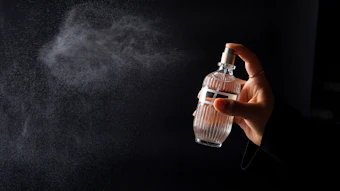
A similar comparison was made for fragrance use using perfume as an example. Using conservative assumptions such as complete dermal absorption and no evaporation, we estimated that reaching comparable dose levels would require tens to hundreds of thousands of perfume sprays per day. Even levels corresponding to established safe use levels would involve use far beyond what is realistic for consumer behavior.
When viewed in this way, the difference in scale becomes clearer. Toxicological studies are designed to identify potential hazards, whereas real-life exposure typically occurs at much lower levels. Both are necessary to understand risk in practice.
Aggregate Exposure and Margin of Safety
In addition to these comparisons, the study examined chronic aggregate exposure to fragrances using the Creme RIFM Aggregate Exposure Model. This probabilistic model integrates consumer use data across all consumer product categories (personal care, cosmetics, household and air care products) and routes of exposure, including dermal, inhalation and oral pathways, and has been described in the literature as a comprehensive approach to estimating real-life exposurec.For both benzaldehyde and p-cymene, estimated exposure levels were low, even for the most loyal fragrance super users. When these values were compared with toxicological thresholds, the resulting Margins of Safety were well above the commonly accepted benchmark of 100 for non-genotoxic substancesd.
Translating toxicological dose levels for piperonal into practical terms indicates that a dose considered safe would correspond to applying approximately 6,000 perfume sprays or twelve 50 ml bottles of perfume a day or eating around 3,000 tablespoons of white pepper per day for a few years.
These calculations are intentionally conservative. Assumptions such as complete absorption and upper-bound exposure scenarios are used to avoid underestimating exposure. Even within this framework, the gap between real-life exposure and levels associated with adverse effects remains large. For example, the Creme RIFM model reveals that total annual exposure to fragrances like benzaldehyde and p-cymene from all fragranced products is less than one drop of the neat material.
Expanding the Real-World Fragrance Safety Framework
RIFM is now applying the same approach to a broader range of fragrance materials, including geraniol, nerol, l-carvone, 1,3,4,6,7,8-hexahydro-4,6,6,7,8,8-hexamethylcyclopenta-gamma-2-benzopyran (HHCB), 6-acetyl-1,1,2,4,4,7-hexamethyltetraline (AHMT), piperonal and others. The objective remains consistent. Toxicological dose ranges are translated into real-life comparisons and supported by aggregate exposure estimates.
Ongoing RIFM calculations for piperonal illustrate the progress of this work. Translating toxicological dose levels into practical terms indicates that a dose considered safe would correspond to applying approximately 6,000 perfume sprays or twelve 50 ml bottles of perfume a day or eating around 3,000 tablespoons of white pepper per day for a few years. In contrast, chronic aggregate exposure across all consumer products is estimated to be very low: less than three drops of the neat material per year.
These comparisons are not intended to simplify the science, but to make it more accessible. They connect established toxicological concepts with real-life experience and can support clearer communication across disciplines. In conjunction with the scientific publication, RIFM is releasing short-form videos on YouTube and Instagram that explain the main takeaways of this work and can be shared.
Biological Relevance and ADME
In parallel with exposure work, RIFM is exploring how absorption, distribution, metabolism and excretion can contribute to the interpretation of toxicological findings.
Toxicological studies are designed to identify potential hazards, but their relevance to human health depends on how a substance behaves in the body. Processes such as metabolism can influence whether a fragrance material reaches target tissues and at what concentration. Differences between species can also affect how findings from animal studies are interpreted.
Considering these factors provides additional context. It helps determine whether the internal dose associated with real-life exposure aligns with the conditions under which effects were observed in experimental systems. This represents the next step toward integrating exposure science and biological relevance.
Conclusion: Rethinking Fragrance Safety Through Real-World Exposure
The study we conducted shows how toxicological data can be better understood when considered alongside real-life exposure. The gap between experimental dose levels and actual consumer exposure is substantial, and it is central to understanding risk.
RIFM’s ongoing work continues in this direction. By expanding the analysis to additional materials, refining exposure estimates and considering biological processes such as metabolism, the goal is to provide a clearer and more complete picture of fragrance safety.
As this work develops, the focus remains consistent. Safety assessment should reflect both the strength of toxicological science and the realities of how fragrance materials are used.
FOOTNOTES
aJoshi K., Bartlett, A., et al., 2026; https://www.sciencedirect.com/science/article/pii/S027323002600036X
bU.S. Food and Drug Administration, 2005, https://www.fda.gov/media/72309/download; Nair and Jacob, 2016, https://pmc.ncbi.nlm.nih.gov/articles/PMC4804402/
cComiskey et al., 2015, https://www.sciencedirect.com/science/article/abs/pii/S0273230015001117?via%3Dihub; Comiskey et al., 2017, https://www.sciencedirect.com/science/article/abs/pii/S0273230017301460?via%3Dihub; Juraimi et al., 2025, https://www.sciencedirect.com/science/article/abs/pii/S0273230024001934?via%3Dihub; Safford et al., 2015, https://www.sciencedirect.com/science/article/abs/pii/S0273230015001233?via%3Dihub; Safford et al., 2017, https://www.sciencedirect.com/science/article/abs/pii/S0273230017300521?via%3Dihub; Safford et al., 2024, https://www.sciencedirect.com/science/article/pii/S0273230023002131?via%3Dihub; Juraimi SA, Scrochi C, Lok J, Api AM, Smith BPC. Incorporating Singaporean habits and practices for cosmetics and personal care products into a global consumer aggregate exposure model. Regulatory Toxicology and Pharmacology: RTP. 2025 Feb; 156:105752. DOI: 10.1016/j.yrtph.2024.105752. PMID: 39613134, https://www.sciencedirect.com/science/article/abs/pii/S0273230024001934; Isabelle Lee, Ben Smith, Brendan Ring, Catherine Barratt, Cesar Scrochi, Fanny Boisleve, Gretchen Ritacco, John O'Brien, John Ryan-Purcell, Nikaeta Sadekar, Olivia Payne, Ruari Zink, Sarah Tozer, Sean Farrell, Anne Marie Api, Integrating new habits and practices data and homecare products into the Creme RIFM aggregate exposure model, Regulatory Toxicology and Pharmacology, Volume 169, 2026, 106097, ISSN 0273-2300, https://doi.org/10.1016/j.yrtph.2026.106097.
dEFSA Panel on Food Additives and Flavourings, 2025, https://efsa.onlinelibrary.wiley.com/doi/10.2903/j.efsa.2025.9606