 "Fragrance is such a personal category," says Rosie Jane Johnston, founder and CEO of by/rosie jane. "When a founder steps away completely, sometimes the emotional throughline can get diluted. You can still have beautiful formulas, but you risk losing that singular point of view–the consistency of feeling that makes a brand recognizable beyond just notes on a page."by/rosie jane
The former celebrity makeup artist turned founder and CEO of by/rosie jane remains personally immersed in every formula the privately owned brand releases—an uncommon level of creative stewardship in today’s scale-first fragrance landscape. What began in 2010 as a single, clean-leaning scent has evolved into a globally distributed portfolio stocked in more than 400 Sephora doors, positioning the brand as an early architect of the modern “skin scent” movement.
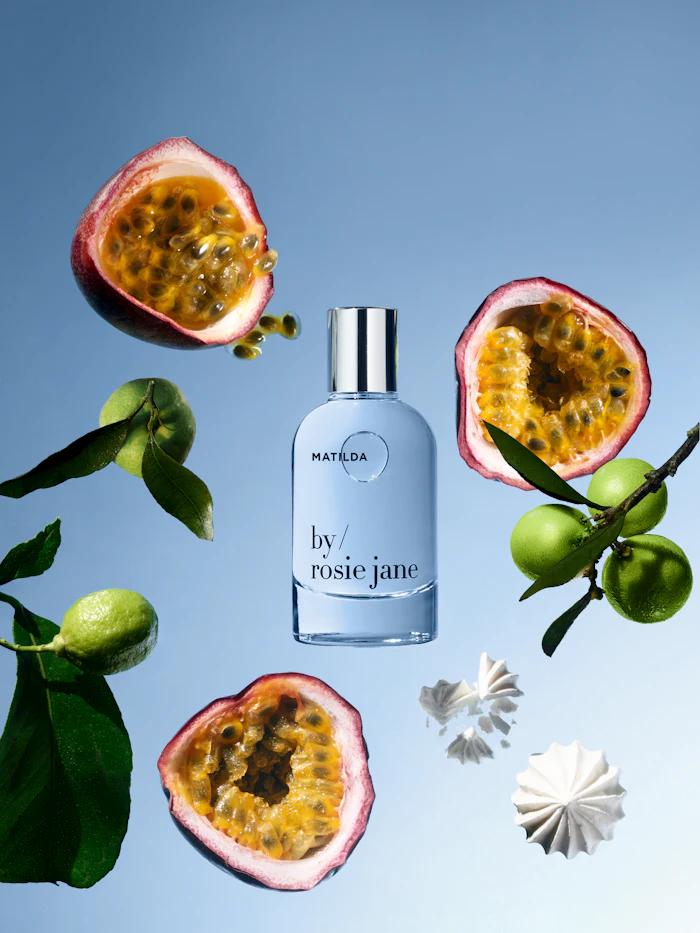
Her newest launch, Matilda, signals both evolution and return. Inspired by her middle daughter, the passionfruit-forward composition deliberately pivots away from the category’s current vanilla saturation, instead pairing bright tropical fruit and airy meringue with a soft, second-skin musk. The result is a study in emotional accessibility: luminous but intimate, playful yet restrained.
In this Q&A, Johnston discusses founder-led formulation in a maturing clean fragrance market, the strategic decision to counter-program against dominant gourmand trends, and how emotional storytelling translates into retail performance at global scale.
P&F+: by/rosie jane has always framed scent around emotion and wearability rather than performance theatrics. As fragrance becomes louder and more experimental, do you see a ceiling for “performative” fragrance–and where does emotional resonance win out?
Johnston: I do think there’s a ceiling to anything that’s purely performative. There’s space for artistry and boldness–I love when perfumers push boundaries–but if a scent is only about projection or shock value, it can feel disconnected from the person wearing it. For me, fragrance is intimate. It sits close to the skin. It should feel like an extension of you, not a costume you’re putting on for attention.
At by/rosie jane, we’ve always centered emotion and wearability because that’s what lasts. Trends may get louder, but people still crave connection. The fragrance someone wears every day–the one their partner recognizes, the one their child associates with home–that’s where emotional resonance wins. It’s less about how far it travels across a room and more about how deeply it lands with the person wearing it.
P&F+: Clean positioning is increasingly table stakes in certain corners of prestige fragrance. In a market where everyone claims “clean,” how do you ensure the philosophy remains meaningful rather than diluted–especially when working with bold, note-forward compositions?
Johnston: When I started by/rosie jane in 2010, “clean” wasn’t a marketing term–it came from genuine curiosity and concern about ingredients. I was researching what I was putting on my skin, and that transparency became foundational to the brand. For us, clean has always been about integrity.
As the space becomes more crowded, the difference is intention. We don’t use “clean” to make something softer or safer creatively–we use it as a framework. You can absolutely create bold, note-forward compositions within thoughtful formulation. It just requires more care, more creativity, and sometimes more patience. Clean shouldn’t limit expression; it should push you to be more interventional about ingredients, packaging, etc., while staying aligned with your values.
P&F+: You’ve stayed personally hands-on with every fragrance as the brand has scaled globally. What do you think gets lost when founders step back from the creative process, and why does founder authorship still matter to today’s fragrance consumer?
Johnston: Fragrance is such a personal category. When a founder steps away completely, sometimes the emotional throughline can get diluted. You can still have beautiful formulas, but you risk losing that singular point of view–the consistency of feeling that makes a brand recognizable beyond just notes on a page.
Every by/rosie jane scent is rooted in someone I love, a chapter of my life, or a moment that shaped me. That authenticity can’t really be outsourced. Today’s consumer is incredibly intuitive–they can feel when something is story-driven versus trend-driven. Founder authorship signals care. It tells the customer this wasn’t created in a boardroom; it was created from lived experience.
P&F+: Motherhood and personal storytelling have become core to your creative lens, particularly with Matilda. How do you translate something as intimate as family, memory, and curiosity into a scent that still resonates at scale with a global audience?
Johnston: Motherhood completely reshaped how I experience scent. With Matilda, it started with curiosity–that childlike wonder, that sense of imagination and softness. But translating something personal at scale comes down to distilling it to a universal emotion.
Instead of recreating a literal memory, I focus on how it felt. Was it comfort? Playfulness? Warmth? Safety? Once you identify that emotional core, it becomes something anyone can connect to, even if their story looks different from mine. The goal isn’t to tell my exact story–it’s to create space for someone else’s. Emotion is universal, memory is universal, and scent is the bridge between them.