In 2006, I was a perfumer student at the Grasse Institute of Perfumery, and I would have friendly conversations with Jean Garnero. He was a chemical engineer and former research director, as well as scientific director at the Robertet and Charabot establishments. He knew about my passion for natural raw materials. During one of my visits, he said to me: "There are three types of perfumers: technical perfumers, artistic perfumers and, finally, those who combine both." Then he asked me this question: "Which perfumer do you wish to be?"
Without hesitation, I answered naturally: "The third one."
And you, which perfumer do you wish to be?
 3D modeling of olfactory cones; created by Pierre Bénard Ségu and Mathieu Laprie, 2021. Pierre Bénard Ségu and Mathieu Laprie
During my studies, the language of perfumery taught us the famous olfactory pyramid. I have always wondered whether this name was linked as a historical reference to Ancient Egypt and its constructions.
The name serves to visualize the structure of a perfume through a three-level reading, represented in flat form as a triangle.
Yet perfume is a volume. It takes the shape of its container, and if it were represented by a polyhedron, it would position itself in the angles.
I prefer another olfactory vision for it, a more curved, rounder version. This led me, in 2020, to file with industrial property institutions the olfactory cone as a representation of an olfactory form, of a natural or synthetic odorous material, of a perfume.
Seen from the front, my shape could resemble that of a target, a boon for marketing departments. I give it a more lyrical idea, like a form of waves caused by a drop, emanating from a perfume.
At the center, the most evanescent molecules, commonly called top notes. If they were associated with the feeling of falling in love, they would correspond to the seat of the emotion that runs through you like a bolt of lightning.
Next would come passion, a love that consumes itself, with the appearance of heart notes.
Around them, delimiting the trail, the base notes, symbols of a lasting yet ephemeral union.
Seen from the side, my conical figure evokes volatility from its base to its summit, the apex. At this apex, the most fleeting molecule could be ethanol in the composition of a fine fragrance.
With this in mind, I modeled my first personal creation for my brand Ozparfum: Lilith, Sombre Héroïne. In the genesis of certain traditions, Lilith is considered the first wife of man. Between sand and clay, shaped like him from the earth's silt by her creator, she was replaced after refusing to submit to her husband's authority. Banished from paradise, she met a fallen angel.
My creative vision of perfume is close to the artistic practice of sculpture, and more particularly to the technique of modeling. This technique consists of designing and creating a volume in which the sculptor, like the perfumer, removes or adds material until achieving the most harmonious aesthetic form.
From these artistic reflections on perfume was born the world's first olfactory data-sculpture, which I named Spectre. The specter of Lilith is a work of the mind, of which I am the Pygmalion and she the Galatea. The artistic process, from idea to realization, from spirit to matter, was also filed in 2025, just like the technical process.
I could have chosen any icon from the market or any perfume of the century. However, my approach is to position perfume as a work of the mind, as a work of art—which is why I chose my own olfactory creation.
Putting a Perfume’s DNA Under the Microscope
The DNA of Lilith was thus analyzed by GC×GC-MS thanks to the team of Professor Mondello and Mariosimone Zoccali, associate professor of analytical chemistry, at the University of Messina.
 Using GC×GC–MS in an artistic manner to showcase the scientific advances in this field and to position olfactory creation, that of perfume, as a work of the mind, an art.Pierre Bénard Ségu
Comprehensive two-dimensional gas chromatography (GC×GC) coupled with mass spectrometry (MS) is currently the most powerful tool for analyzing compounds compatible with GC. This technique is completed by the use of MS as a third dimension, after two stages of chromatographic separation.
 Using GC×GC–MS in an artistic manner to showcase the scientific advances in this field and to position olfactory creation, that of perfume, as a work of the mind, an art.Pierre Bénard Ségu
The instrumentation and data processing tools are state-of-the-art. For perfumes and cosmetic products, GC×GC is used for targeted quantitative analyses (for example, suspected volatile allergens) and for fingerprinting, for instance for authentication, fraud detection, and the identification and characterization of potent odorants. This high-end precision positions the form created from this perfume formula as a form of a unique, authentic, identifiable, authenticatable scent.
The range of applications of GC×GC–MS remains to be explored; OsmoArt sees in it a future perspective for the field of art and for the perfume industry.
The Shape of Lilith
Stripped down to its molecular essence, my fragrance was analyzed using GC×GC–MS, allowing its composition to be translated into a three-dimensional form.
 Spectre was presented as part of "From Matter to Spirit" (De la matière à l'esprit), the theme of the inaugural edition of Scent, a contemporary olfactory culture exhibition that took place in Milan, Italy, from March 27 to 29, 2026.Pierre Bénard Ségu
From this study, the analytical data collected made it possible to give substance to the impalpable: Lilith's shape modeled.
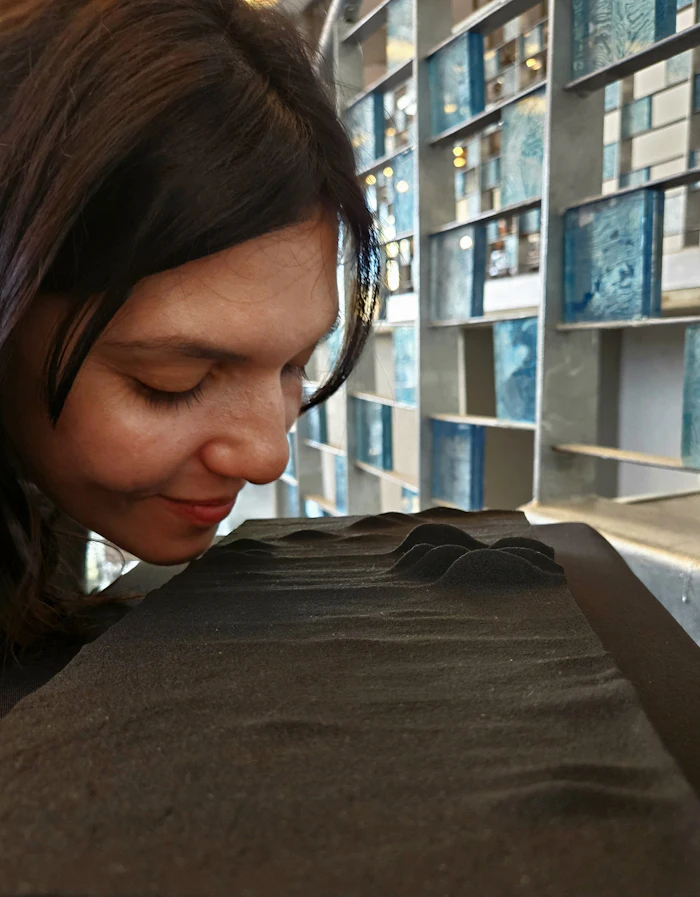
In collaboration with artist and designer Eva Vedel, we transformed this digital file into what we believe to be the world’s first three-dimensional printed olfactory data-sculpture of a perfume—based on my creation, Lilith, Sombre Héroïne.
In 2025, these first unique creations were tested on various media in polylactic acid or in black sand—the latter allowing the work to be smelled—bearing witness to my artistic and scientific process put into practice.
Could the “DNA” of Scent Protect a Fragrance?
In terms of perspective for the industry, this challenge of the immaterial that I set for myself could well change the perfumer's vision and open a door toward the protection of a fragrance, just as a .wav file, a sound spectrum, is protected in the music industry.
I am a member of the International Society of Perfumer-Creators. The intellectual protection of an olfactory creation is a subject at the heart of industry discussions. Copyright is an intellectual property right granted to creators of original works to defend their creations.
The industry has always relied on the realm of trade secrecy, rather than filing a patent, which requires disclosing the formula to the public (which falls into the public domain after 20 years). The formula must remain confidential information. This secrecy is legally secured through contracts, non-disclosure agreements or non-compete clauses.
If the scent is the result, the formula is the technical process (the list of chemical ingredients and their dosage) used to achieve it. Thus, the olfactory spectrum would serve as the guarantor of the visible form of the perfume, its identity card.
In France, the Court of Cassation considers that fragrance stems from the application of technical know-how, and not from a purely creative artistic approach that can be identified with sufficient precision. Yet perfume is born through the perfumer's mediation, through their mind, and it demands extreme precision in the dosing and quality of raw materials, whose analyses are becoming increasingly sophisticated.
Thus, my process of creating olfactory data-sculptures could be of interest to the perfume industry, as it fixes in time the mapping, the identity card, the DNA of an olfactory creation.
As for my artistic perspectives, other olfactory data-sculptures that I call Spectre are currently being produced, notably that of my perfume Yurei, the fragrance of a ghost. The specter of the specter as a philosophical layer. An ectopl[eon]asm, as I call it—a neologism invented to implant a new word and stimulate the imagination.
 Study for the olfactory data-sculpture of Lilith in Carrara marble, 2026.Pierre Bénard Ségu
My first olfactory data-sculptures are mortal. They are printed in biodegradable polymer and in sand. This work of the mind must become timeless and endure through the most durable materials. My project is to fix Lilith's specter in marble, as if to wrest time away from its own transience, to strip her perfume of its volatility, to render it dense, irreversible, almost sacred.
In this quest for timelessness, the choice of material becomes essential: Carrara marble, the marmor lunensis of the Ancients, stands out as the obvious choice. Lilith is a soliflore tuberose, which, as they say in Japan, is the flower that perfumes the air beneath the moon. This white flower resonates within this cold, luminous marble, sometimes crossed with subtle veins, like traces of memory. It carries within it a rare tension between purity and depth.
Since antiquity, Carrara marble has been extracted from the Apuan Alps, in the region of Carrara, and it continues to embody an idea of permanence, almost a suspension of time. To work this marble is less to create a form than to crystallize a moment: that of the perfume.
Each block extracted becomes a promise—the promise of transforming the volatile into the durable, the living into a trace, the ephemeral into presence.
 Another project, probably more ambitious, would be to build Lilith's specter as an immersive installation on a human scale. Pierre Bénard Ségu
Another project, probably more ambitious, would be to build Lilith's specter as an immersive installation on a human scale. In this way, the public would literally step inside the perfume, into an inter-molecular space, into an olfactory and spatial field where the entire body becomes a volatile body and circulates freely within the work.