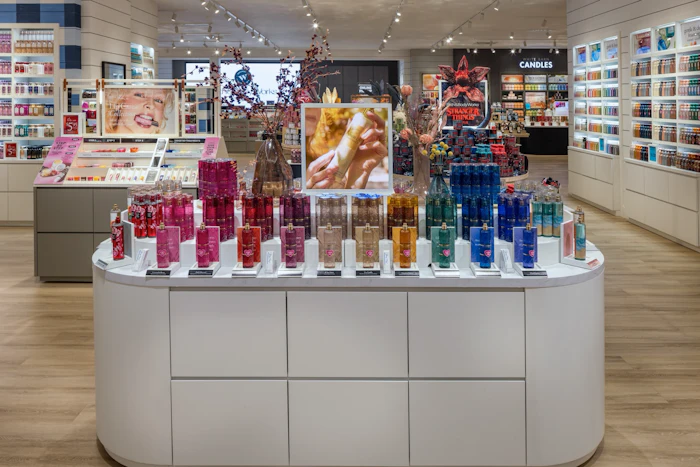
Bath & Body Works continues to prove that affordable indulgence remains one of beauty’s most resilient growth engines, even as consumers pull back across much of discretionary retail.
The specialty fragrance and body care retailer reported first-quarter results ahead of guidance, with executives pointing to early traction from its “Consumer First Formula” strategy as the company works to modernize the brand, strengthen hero categories, and deepen consumer engagement in an increasingly volatile market.
Net sales fell 3% to $1.38 billion for the quarter, but still exceeded company expectations, while adjusted earnings per share came in above guidance at $0.32. Importantly for investors, Bath & Body Works reaffirmed its full-year outlook despite ongoing macroeconomic uncertainty, softening consumer sentiment, tariff concerns, and continued pressure across broader retail.
The performance highlights a dynamic playing out across beauty and fragrance: consumers may be trading down on big-ticket discretionary purchases, but many are still spending on emotionally rewarding, accessible luxuries, particularly fragrance-driven products that deliver comfort, escapism, and routine-based self-care.
Few brands are better positioned for that environment than Bath & Body Works.
The company sits at the intersection of several durable beauty trends reshaping the market: fragrance layering, scent-driven wellness, home ambiance, gifting, and “treat culture.” Its core categories — fine fragrance mist, body care, soaps, sanitizers, and candles — offer relatively low entry prices while still delivering the sensory and emotional payoff consumers increasingly seek during uncertain economic periods.
That positioning has become especially powerful as fragrance continues outperforming nearly every major beauty category globally.
Bath & Body Works has also benefited from its unusual ability to operate simultaneously as a mass retailer, a fragrance destination, and an experiential shopping environment. Frequent product drops, strong seasonal storytelling, highly recognizable scent franchises, and an aggressive promotional cadence continue driving traffic and repeat purchasing behavior.
CEO Daniel Heaf acknowledged the business still has work to do, saying current results remain “below the standard our brand is capable of delivering.” But he also pointed to encouraging signs that the company’s turnaround initiatives are beginning to resonate with consumers.
Much of that strategy appears focused on making the brand feel more culturally current without abandoning the core formula that built its scale. The retailer has increasingly leaned into elevated fragrance positioning, expanded premium formats including eau de parfum, improved visual merchandising, and sharpened focus on its strongest scent-driven categories.
At the same time, Bath & Body Works retains a structural advantage many beauty brands would envy: extraordinary distribution reach. The company operates more than 1,900 stores across North America alongside a growing international footprint and expanding digital business, allowing it to meet consumers wherever value-oriented beauty demand emerges.
The retailer is also benefiting from a broader consumer shift toward “everyday luxury” behaviors/smaller, emotionally satisfying purchases that feel justifiable even during periods of financial caution. In beauty, fragrance has emerged as one of the clearest beneficiaries of that psychology.
Candles, body mists, and personal scent products increasingly function less as simple consumables and more as mood-management tools tied to comfort, identity, and wellness rituals. Bath & Body Works has spent decades building expertise precisely around those emotional consumption triggers.
Investors appear cautiously optimistic. While the company maintained guidance for sales declines this year, it also reiterated expectations for approximately $600 million in free cash flow generation in 2026, underscoring the continued cash-generating strength of the model even amid uneven top-line growth.
The company also announced that CFO Eva Boratto will step down in June, with longtime finance executive Tom Javitch appointed interim CFO while a broader search is underway.
For the beauty industry, however, the bigger takeaway may be this: in an uncertain market, consumers are still making room for fragrance-led joy. And Bath & Body Works remains one of the clearest examples of how scale, sensory experience, and affordable indulgence can continue driving resilience even when broader retail demand weakens.