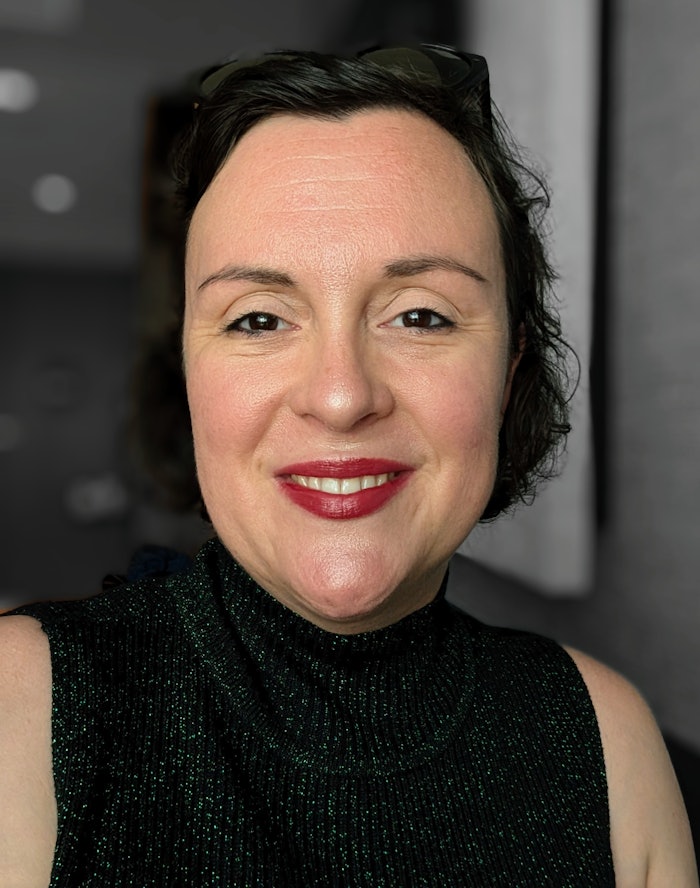
Name: Delphine Perdon Rupnow
Title: Perfumer
Location: Northbrook, Ill, USA
What led you to the fragrance industry?
My passion for scents began early in my youth, driven by the profound emotional connection I felt with the sense of smell. Knowing this was my calling, I strategically chose to study fine chemistry to prepare for a career in the perfume industry, and I obtained two master's degrees specializing in organic chemistry and flavors & fragrances from the Universities of Versailles and Montpellier in France. This dedication eventually led to key internships in the Paris region, at an essential oil company, Duclos Trading (now Azelis), where I developed a deep understanding of natural ingredients, as well as at the Colgate Palmolive Creative Center in Paris.
Can you share a defining moment or breakthrough in your career as a perfumer?
I had several significant moments in my career, which corresponded each time to a move to a different country! The first was moving from France to Singapore to join Sillage Aromatique (now Bell Flavors & Fragrances) in 2009. This was a pivotal moment: the start of my industry career through an analytical lens. I had the privilege of working with talented perfumers, such as Philippe Barberousse, who helped guide my initial steps.
The next crucial transition was my move to the Bell Flavors & Fragrances headquarters in Northbrook, Ill., USA in 2017. This marked a time when I truly began to spread my wings as a perfumer and work alongside exceptional colleagues, including my mentor, Robert Siegel.
What were some of the biggest challenges you faced when entering the perfume industry, and how did you overcome them?
When I relocated to the U.S., one of my biggest challenges was finding a perfume community that offered the same sense of belonging I had experienced with the SFP (Société Française des Parfumeurs) back home. Despite the fragrance industry being largely concentrated on the East Coast, the American Society of Perfumers (ASP) stood out, and its members were incredibly welcoming! I decided to support the organization, starting by managing their social media while working my way up to membership. My involvement on the board grew from apprentice director to director, and now I proudly serve as one of the co-vice presidents with Paula Kundu, working closely with our President Roger Howell. I am so grateful for the amazing people I get to meet along the way!
Can you describe a time when a fragrance formulation didn’t turn out as expected? How did you address the issue?
It is a reality that mistakes happen in formulation, particularly during a perfumer's initial training or when testing a new unfamiliar ingredient. A frequent example is overdosing on raw material. Though a possible, if often laborious, workaround is to try to dilute the overpour by adding more "noise" to the formula, the most effective solution is to simply start fresh and increase slowly the level of the target material to pinpoint the ideal dosage for the desired effect, working with an accord or a "coeur" if needed.
With time and consistent practice, these errors diminish, as we learn how to use and tame the ingredients, and yet the occasional surprise (good or bad) remains possible. That's the unpredictable magic of creative formulation!
How do you find the right balance between artistic expression and the technical limitations of perfume formulation?
I find that the relationship between creativity and constraints becomes a strength over time. As young perfumers, we start with unrestricted artistry, trying to perfectly capture nature with almost no restriction but the palette itself. However, when technical challenges are introduced, having to achieve a specific result, whether maintaining a very low cost for an impactful fragrance, an increased list of allergens, or dealing with sourcing issues — is both complex and incredibly rewarding. In a constantly evolving world of restrictions, the perfumer's agility is essential, proving that nothing is truly impossible. Navigating those limitations rationally is also a form of creativity on its own, one that keeps us alert, grounded and sparks excitement.
Are there specific skills or knowledge areas you believe are crucial for a perfumer to master?
In my opinion, success as a perfumer demands several key qualities. Firstly, the agility I mentioned, and the ability to embrace challenges by working outside one's comfort zone, maintaining a flexible work approach. Secondly, a perfumer must possess a deep historical and contemporary market knowledge, meaning they must have a sharp memory for iconic references and an ongoing curiosity for current products. This extensive portfolio of scented memories is as important as maintaining ingredient knowledge. They are also the common professional language used to work within the creative team, with peers and evaluators. Finally, and perhaps most importantly, passion must drive the work, backed by a resilient and diligent character, necessary to face the frequent rejections and the numerous required reworks.