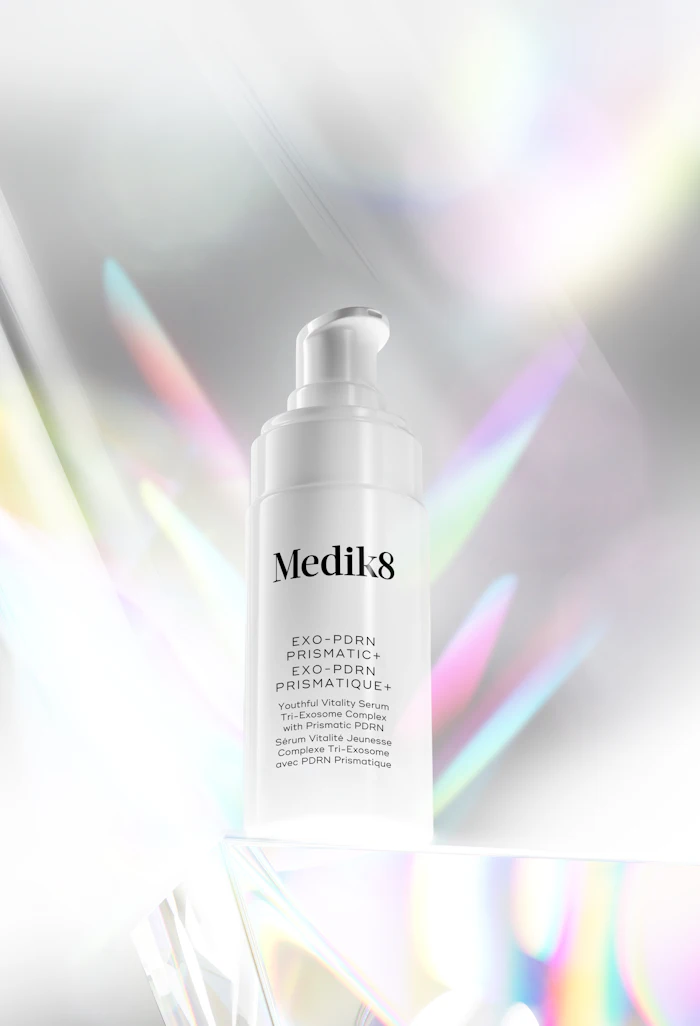
 Medik8’s new launch is one of the clearest commercial signals yet that the category is entering a broader prestige skin care phase.Mediki8
Long associated with Korean aesthetic medicine and injectable skin rejuvenation procedures, polydeoxyribonucleotide (PDRN) has rapidly evolved from niche clinical ingredient to mainstream beauty positioning platform. Traditionally sourced from salmon DNA, PDRN has become increasingly associated with wound healing, post-procedure recovery, collagen support and “skin regeneration” narratives. But alongside growing consumer awareness has come mounting pressure around sourcing, sustainability, scalability and vegan compatibility.
That pressure is now driving a new innovation cycle centered on bioengineered, algae-derived and biomimetic PDRN alternatives.
Medik8’s new launch is one of the clearest commercial signals yet that the category is entering a broader prestige skin care phase.
Rather than relying on marine-derived DNA, the company positions its “Vegan Prismatic PDRN” as a next-generation alternative engineered with a tetrahedral structure designed to optimize skin penetration and recovery support. The formula combines the ingredient with a Triple Exosome Complex delivering up to 151 billion exosomes per bottle, alongside a Growth Factor MiniProtein and ATP precursor technology designed to reinforce broader regenerative positioning.
The messaging surrounding the launch closely mirrors the wider language now dominating longevity-oriented beauty: cellular communication, skin recovery, visible vitality, barrier resilience and optimized rejuvenation processes.
Importantly, Medik8 is framing the serum as infrastructure for healthier biological skin function itself — particularly in conjunction with professional aesthetic procedures. Claims around redness reduction, post-treatment recovery, barrier reinforcement and “natural rejuvenation” place the launch directly within the rapidly expanding overlap between medical aesthetics and prestige retail skin care.
That crossover is becoming one of the defining trends in advanced beauty formulation.
PDRN’s growing visibility has largely been fueled by South Korea’s aesthetic market, where salmon DNA injectables and topical regenerative treatments gained traction through clinics before moving into consumer skin care. But as the ingredient globalizes, brands and suppliers are increasingly searching for ways to retain the regenerative narrative without the sourcing complications associated with fish-derived materials.
That is where vegan and PDRN-inspired technologies are beginning to reshape the competitive landscape.
In 2025, Amorepacific published significant research on microalgae-derived PDRNs extracted from Chlorella protothecoides. The company’s BluePDRN platform demonstrated wound-healing and collagen-supporting activity comparable to conventional salmon-derived versions while offering a fully non-animal alternative. Notably, the company reported that the microalgae-derived molecules were substantially smaller than traditional fish-derived PDRNs, potentially improving penetration and bioactivity.
The implications extend far beyond ingredient substitution.
By shifting PDRN sourcing toward biotechnology and controlled fermentation-style production systems, companies gain advantages in reproducibility, sustainability, traceability and scalability — all increasingly important for global regulatory and ESG positioning. For multinational beauty players, vegan PDRN also avoids some of the cultural and ethical sensitivities associated with animal-derived biomaterials.
At the ingredient supplier level, the market is rapidly diversifying beyond direct PDRN replication into broader “PDRN-inspired” regenerative systems.
Kalichem has introduced Kaligen, a plant-based nucleobiotic complex designed to mimic regenerative signaling pathways associated with PDRN while supporting collagen activation, replumping and skin longevity positioning. Rather than focusing strictly on DNA fragments themselves, the ingredient taps into biomimetic regenerative biology and multi-layer dermal restructuring narratives increasingly favored in premium anti-aging launches.
Meanwhile, Clariant’s Lucas Meyer Cosmetics division has approached the category through blue biotechnology with AlgaSurge, a sulfated polysaccharide hydrogel derived from extremophile microalgae. Positioned as both a hyaluronic acid and PDRN alternative, the ingredient emphasizes durability, autophagy restoration and long-term skin longevity support rather than short-term hydration alone.
What is emerging is a broader reframing of regenerative beauty itself.
The original commercial success of PDRN centered heavily on “salmon DNA” novelty and clinical procedure adjacency. The next phase appears far more sophisticated: bioengineered regenerative systems combining exosomes, growth factors, peptides, ATP-support technologies, microbiome modulation and biomimetic signaling into layered longevity platforms.
Medik8’s launch encapsulates that evolution.
Its serum merges multiple high-science narratives currently converging across prestige skin care: exosomes, regenerative recovery, cellular energy, growth-factor-inspired signaling, skin longevity and non-animal biotechnology. In doing so, the brand positions vegan PDRN less as a replacement for salmon DNA and more as part of a larger systems-biology approach to skin rejuvenation.
For formulators and marketers, the competitive challenge now shifts toward substantiation and differentiation.
As regenerative language proliferates, brands will increasingly need to prove not just hydration or wrinkle reduction, but measurable effects on barrier recovery, inflammation modulation, collagen pathways, fibroblast activity and post-procedure outcomes. Delivery systems, molecular size, penetration efficiency and bioavailability are likely to become critical battlegrounds.
At the same time, consumer demand continues moving toward formulations that feel simultaneously clinical, ethical and future-facing.
That combination may explain why vegan PDRN alternatives are gaining traction so quickly. They preserve the high-tech regenerative aura that made salmon-derived PDRN commercially compelling while aligning more naturally with clean beauty, biotechnology and sustainability narratives now shaping prestige skin care globally.
The result is a category rapidly evolving from niche K-beauty curiosity into one of regenerative beauty’s most commercially important next-generation platforms.