Berjé Inc. and its South African farming partner, Waterfall Health Farms, have won bronze in the Small & Medium Enterprises (SME) category of the 2026 International Federation of Essential Oils and Aroma Trades (IFEAT) Sustainability Awards for their work to secure a more sustainable future for buchu.
Recognized at the IFEAT Conference in Bangkok, the award honors "The Buchu Model: Cultivating Sustainable Partnerships," an initiative developed with the Buchu Association and the National Khoi and San Council. The project combines responsible cultivation, supply chain traceability and community investment to address growing commercial demand while protecting a botanically and culturally significant South African resource.
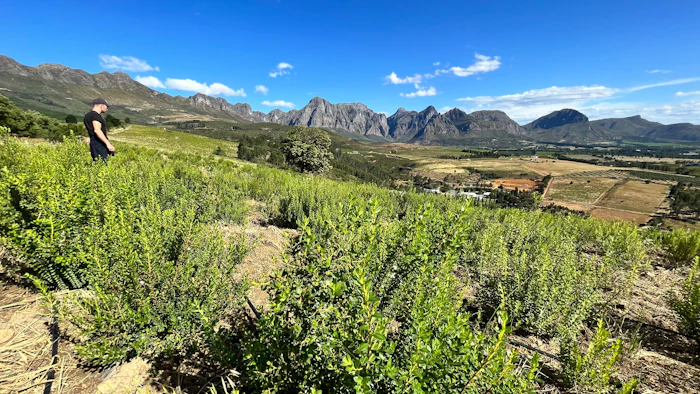
Buchu is indigenous to South Africa’s Cape Floristic Region, where drought and wildfires have placed additional pressure on wild populations as demand for the botanical has increased. The partnership aims to reduce reliance on wild harvesting while establishing a more secure supply chain for the ingredient.
 Buchu is indigenous to South Africa’s Cape Floristic Region, where drought and wildfires have placed additional pressure on wild populations as demand for the botanical has increased. The partnership aims to reduce reliance on wild harvesting while establishing a more secure supply chain for the ingredient.Berje
Cultivation and Traceability Drive Supply Chain Change
Responsible cultivation now provides the majority of commercial buchu supply. During the 2025-2026 season, wild harvesting accounted for just 4.36% of total volume, according to the project. The supply chain is also fully traceable to the farm, growing block, grower and supplier, providing greater visibility into ingredient sourcing.
Water conservation is another focus. Water use across irrigation, the distillery and housing fell 28% between January and September 2026 compared with the same period in 2025. Water-saving measures include nighttime drip irrigation.
Community Benefits Built Into the Model
The partnership also incorporates an access and benefit sharing framework, allocating a budget equivalent to 4% of turnover to community benefits. This supports skills development and direct engagement with Khoi and San Traditional Knowledge Holders.
Additional initiatives have supported improvements to housing, sanitation, safety and transport. A "Buchu Short Course" has also been developed to build skills and knowledge related to the botanical.
Bringing together 53 stakeholders from industry, government, traditional knowledge holders and the wider supply chain, the project offers a model that its partners say can be adapted to other botanical and natural ingredient supply chains.