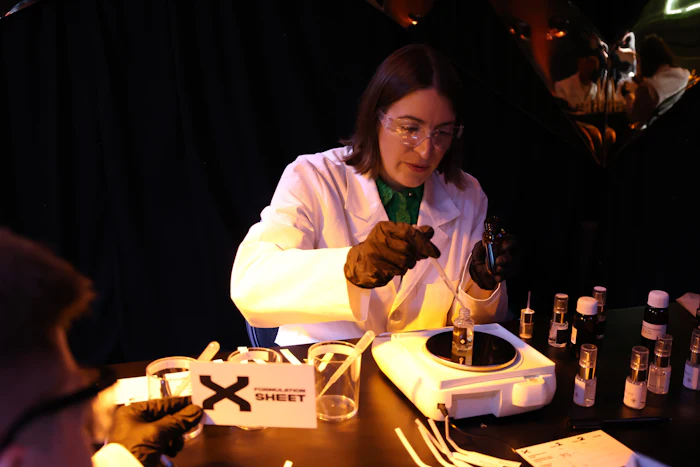
When it comes to elevating a brand, or in the case of AXE/Lynx, re-elevating a brand, there are a thousand things to consider. Making it impactful on a sensory level, is the reason the fragrance industry exists. We got a chance to connect with Noémie Lottiau, Fragrance Design Leader for Personal Care, and talk about what goes into taking a brand founded in fine fragrance back to its roots, from ingredients to a complete fragrance.
Perfumer & Flavorist+: Getting the brief, understanding AXE’s goal. Where did you start? How did you get to the final product?
Noemie Lottiau: We look at the early signals and then get an understanding with the brand: what interest in olfactive territories do we want to bring to our collection? What are the early ingredients that could be interesting to claim? Figuring out which ingredients could resonate with our consumer.
From that, we are in line with the brief, so we brief the fragrance houses. We will smell together, not a fragrance at the beginning, but some ingredients. So they have ingredients in their palate that are specific. The vanilla CO2 from IFF from LMR. There is the roasted hazelnut accord; from that, we will develop the fragrance.
We want the perfumers to be creative. We don't want them to be restricted at the beginning. It's just brainstorming; we can be inspired by food, by fashion. All of this is going to inspire us for further creation.
PF+: Is there anything like a mood board in this process? You were talking about listening to what consumers are saying on TikTok, data and early trends.
Lottiau: Not always, but yes, sometimes we can have mood boards that could inspire the perfumer. So actually, so it could start from an ingredient we smell together, let's say the vanilla CO2 or, for example, the white vetiver. Vetiver is a very important ingredient in perfume and is part of the heritage of perfumery. But we wanted to modernize it to our Gen Z audience.
We see a lot of classic structure; it’s a fougere that's been here for the male perfume since the beginning of perfumery, but we wanted to modernize it, to twist it.
So there is always a bit of direction, but the first important thing is brainstorming, which is where we smell accords. From a brand point of view, there may be more concepts or olfactive trends that would make sense.
PF+: Taking that just a little step further. How does that manifest in the conversation phase? What does that look like in deliberating and weeding out things that are further from what you want?
Lottiau: As you say, perfumery is an art. Everyone is sensitive to different types of smells, you know, depending on your background and what you are smelling. Smell is really linked to your emotions, so what you're smelling until you are 10, 12 years old will really be in your memory.
That's why we don't answer the same way to fragrance. To create it is very important, but of course, we also need to make sure it's linear and long-lasting. That's why we are lucky at AXE to work with fine fragrance perfumers who have access to exclusive ingredients. They are also the ones who create niche, mainstream, and fragrance, so they know how to design premium fragrances.
At the same time, they need to be adapted for AXE and easy to understand. We need to bring back the rationale: We are designing for AXE.
What is our portfolio? Which ingredient could be interesting to communicate, to talk about, that we don't have in our collection and could resonate with our consumer?
And then, after, involve our marketing person, who will have a vision of how the full experience should be. Because yes, it's a fragrance, but you also have the sensory, the color of the name, the color of the of the packaging. All of this, we work together to make sure we have a realistic product.
PF+: You've worked with a lot of trends creating this fragrance. Are there any trends you're seeing come up that you think are going to be big or that are going to have an impact on fragrance moving forward?
Lottiau: We see different types of gourmand now, for example, we see a lot of vanilla powder, spice, a lot of savory, more and more. We're having this sweet and savory, unexpected pairing.
Also ingredients from all over the world, a lot of matcha, we see ube. We are really inspired by the food industry.
For me, I see a lot of classic structure coming back to the new consumers. So we talk about classic fougere, classic cologne, we see the rise of cologne and citrus, like bergamot, because for this generation, it is new.
I see a lot of fresh, metallic notes [like] sea salt and fruits [like] strawberries are having a very big moment, after cherries [and] salty pistachio.
We start to see some brands that are really looking at more elemental elements: stone, copper, all kinds of ingredients from nature. Wellness, of course, is a very important trend.
PF+: Your role as a Fragrance Designer doesn't just stop once the fragrance is made. You take all that information from conception. Beyond the formulation process, to actually engage with the rest of the teams in deciding the packaging and helping build the vision around the fragrance.
Lottiau: Fragrance is most important for AXE, but we also work with our formulation team to develop the fragrance because when you approve the fragrance, after you go into what we call stabilities, to ensure that the fragrance is stable, that there is no discoloration.
There is a lot of richness in this role because it's not only the creative part that I love, but I work with a fragrance house on this, I meet with a perfumer, with an evaluator, with the marketing department also that will have all this insight. It's all about being creative altogether, inspiring our consumers, inspiring our marketing, and really ensuring that we are the trendsetter.