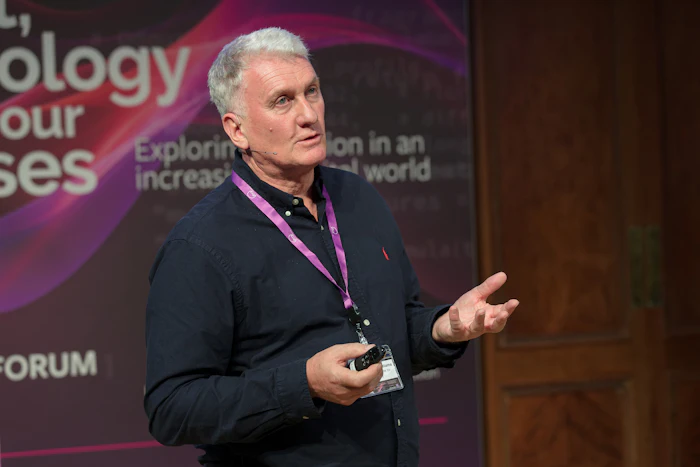
What if you could capture the smell of a forest, transmit it through your smartphone and recreate the experience somewhere else in the world? The science of digital olfaction is moving closer to making that possibility a reality. At IFRA UK’s Fragrance Forum 2026 in London, Professor Jonathan Williams of the Max Planck Institute for Chemistry explored the science behind translating airborne chemistry into recognizable, reproducible smells. From advanced mass spectrometry and real-time volatile organic compound (VOC) detection to algorithmic odor mapping and scent recreation, his research is helping tackle one of digital technology’s biggest sensory challenges: making smell as transferable as sound and images. In this Q&A, Williams discusses the technical hurdles, potential applications and what digitizing olfaction could mean for fragrance development, environmental research and everyday experiences.
What is the biggest scientific obstacle to translating a chemical profile into something that accurately reproduces how a person perceives a smell?
Williams: There are essentially three parts to the problem of digitizing smell: detection; an algorithmic map of odors; and means of recreating the original smell.
The first part is the selection of a sensor that can rapidly supply sufficient chemical information for an ambient odor to recognized. While many high-end devices exist to measure volatile organic compounds in air, many commercial instruments are either too slow, unable to distinguish key olfactory compounds, or simply too big and expensive. Once a suitable device is selected, the odor must be recognized or identified and subsequently located in an odorspace, a multidimensional map of odors.
The next great challenge is then to identify a set of ‘primary’ odors that lie on the periphery of the odorspace map, such that sets of the primary odors can be combined through linear addition to land at the smell’s location.
Then, to recreate the odor the primary components are combined to deliver an odor that is similar enough to the original as to be identifiable. This also requires a device to be built so that vapors can be dynamically mixed in the gas phase in different proportions to recreate the measured odor. Five years ago, I would have said the biggest obstacle would be the construction of the odorspace map. However, several groups are closing in a working version of this. Now I believe the measurement and connection to odorspace represent the biggest problem to be solved.
How might the ability to measure and recreate smells in real time change the way we study the environment, develop fragrances or understand the role of scent in everyday life?
Williams: The ability to share a smell experience with someone remotely would open new areas for human creativity as well as new practical applications. Imagine taking a countryside walk, while filming online the experience with your phone. If in addition to the images and sound you could stop and send authentic smells of pine trees, flowers, strawberry fields, a smoke plume, a food truck, some rotting fruit, the experience of the viewers/listeners/smellers would be enhanced and more real.
On a more practical angle, if the odors can be faithfully transmitted, smells could be shared with a remote healthcare giver to aid in diagnosis. Or imagine if, as your favorite TV chef takes a new cake out of the oven you could smell the result in your own home. I think if technology can enable these things public interest and awareness of the smells around them would increase. It would allow fragrance developers to work together, cooperatively on a fragrance.