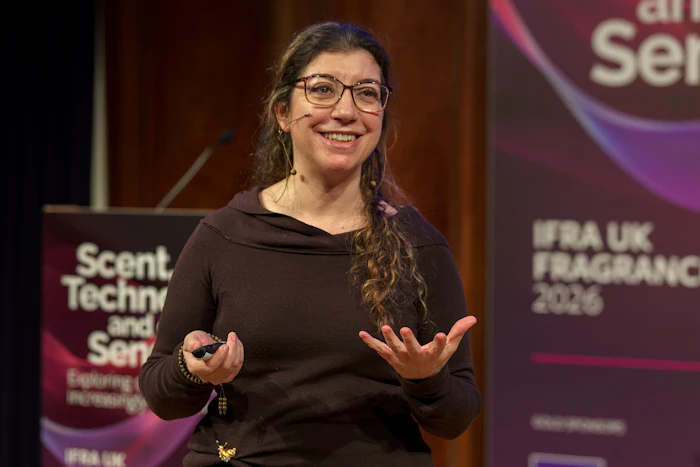
As digital technologies reshape how we capture, interpret and recreate scent, a fundamental question emerges: Can a smell ever be fully digitized without losing the memories, cultural meanings and human experiences that make it matter? At IFRA UK’s Fragrance Forum 2026 in London, Cecilia Bembibre, Ph.D. of University College London explored the challenges of preserving olfactory heritage in an increasingly digital world. From analyzing the molecular signatures of historic objects to documenting the personal memories and cultural associations behind familiar smells, her work highlights why chemistry alone cannot tell the whole story. In this Q&A, Bembibre discusses the intersection of olfaction, science and cultural heritage—and how digital tools can help safeguard the smells that connect us to people, places and the past.
How do you decide which aspects of a smell are essential to preserve, particularly when its cultural meaning may be more important than its precise chemical composition?
Bembibre: We start from the idea that a smell is heritage because of what it means to people. For that reason, our first step is a significance study, which documents to whom a smell matters, why it matters, and what value there is in preserving it for future generations. This means engaging with the communities, places and objects connected to it. For example, we worked on preserving the smell of the interior of a Rover P5B at the British Motor Museum, a car owned and used by the late Queen Elizabeth II. The smell is significant because of its royal connection, of course, but we also interviewed dozens of classic car collectors, who told us about the memories the car’s smell evoked and shared stories about the smells of their own vehicles.
From these conversations, a set of shared values around the smell of cars emerged, and these became part of our archive. Alongside this, we analyzed the volatile organic compounds (VOCs) from the car’s interior, both chemically and perceptually, to build a complete record. So, I would say the essential elements are often the descriptors, narratives and contexts, with the analytical data serving as an anchor that makes the record reproducible and comparable over time.
How can participatory projects ensure that digital records of olfactory heritage reflect diverse communities and lived experiences, rather than privileging the smells that scientists can most easily measure or reproduce?
Bembibre: When we conducted a study of nine mummified bodies in the Egyptian Museum in Cairo, we worked with Egyptian colleagues and realized that the way they described and interpreted the odors was quite different from ours. The study aimed to explore non-destructive approaches to learn more about this heritage, and one of the methods we used was olfactory analysis. We were a diverse team of heritage scientists, archaeologists and microbiologists, as well as conservators who knew the collection intimately.
Through analysis, we were able to identify four different sources of the smells and match the molecular data with perceptual descriptors, through both gas chromatography-olfactometry and odor evaluation panels conducted in the museum. In the panels, it was key to hold many conversations to agree on a shared set of descriptors, because trained analysts used very different terms from museum staff, who had the most experience and knowledge about the smells but used their own terms in a different context, mostly to inform conservation decisions and manage the collection.
In a different project, the U.K. Smell Inventory, we are asking members of the public to contribute to an inventory of smells they would like to safeguard for the future. Participants are completely free to use their own words and record their personal memories and experiences. Yet clear patterns emerge in the smells people want to keep, such as those associated with nature (flowers, forests), industry and transport (trains, steam, coal), household and personal care products (brand names of soaps and washing-up liquids), specific places (libraries, schools) and practices (cooking, religious rituals). The language people use carries cultural meaning and enriches this archive, reminding us that olfactory heritage is defined by those who live with it.
Projects like Odeuropa have also widened the lens by drawing on historical texts and images across many European languages, showing how smell meanings vary between places and periods. The next step is to do the same with living communities, especially those whose heritage has been underrepresented in museums and archives. In the OLFACTREE project, which starts next year, I will be working with communities in El Salvador, China and Oman to understand how olfactory knowledge around incense trees such as Peru balsam, agarwood and frankincense can help them sustain their practices and adapt to the impact of climate change.