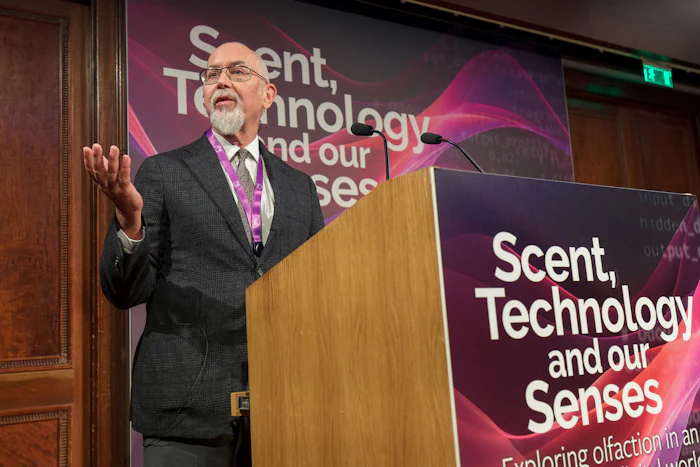
What would it take to send a smell through your smartphone—and would digitizing scent change what makes it meaningful in the first place? At IFRA UK’s Fragrance Forum 2026 in London, Professor Simon Niedenthal of Malmö University explored the emerging frontier of digital olfaction, from electronic noses and virtual environments to interactive scent experiences.
In this Q&A, Niedenthal and colleague David Kadish, developer of an electronic nose, discuss the technical and design challenges of capturing and reproducing smell, why context and human perception remain essential, and where digital olfaction could find its most compelling applications. Their perspective suggests the future may not be about recreating the smell of the physical world, but opening up entirely new ways to experience scent.
What do we risk losing, and how might designers preserve what makes olfactory experiences meaningful?
Niedenthal and Kadish: The first thing at risk is the specialness of smell itself. We tend to talk about smell as a sense that is hard to record and hard to transmit, and so must be experienced in the moment, in physical contact with its source. Part of what makes it meaningful comes from that necessity of being there. The very ability to record and replay it makes it a little less that.
The second loss is context. Smell is rarely experienced alone: we process it alongside what we see, touch and hear, and we lean on that context to make sense of it. Digital images and sounds already show what happens when a stimulus is cut loose from the thing that made it. Sound study has a term for this, R. Murray Schafer's "schizophonia": the strangeness of hearing a sound separated from its source. We suspect a disembodied smell risks the same fate, becoming uncanny rather than satisfying.
It also helps to ask what digital olfaction would replace. People already share smells across distance. Someone recently gave one of us a book with lavender pressed between the pages. An olfactory display could reproduce the lavender, but not the gesture, the paper, or the way the two scents mingle.
We should be equally honest about fidelity. A digital camera is very close to film; an electronic nose is not close to a human nose. Its data is a long way from our perceptual experience, so we will have to accommodate something different rather than expect a copy.
That difference is also where the gains are. An e-nose never tires, never adapts and is always on, none of which is true of human olfaction. Building one has made us appreciate how essential human perceptual evaluation is: the data means nothing until we can map it onto human experience. Seeing smell from a machine's perspective may teach us a good deal about our own.
For designers, the key is affordances. An analogue object affords what it affords simply by being what it is; a digital one does not, so those qualities must be designed back in. In practice that means keeping smell attached to its multisensory context, pairing it with the sight, touch and sound of its source, rather than treating it as a free-floating data stream.
Which area has the greatest potential for everyday life, and what challenges remain?
Niedenthal and Kadish: We see the nearest potential in curated, designed experiences, where scent output is one part of an interactive system, rather than in everyday "capture and share." Digital olfaction covers both sensing and output, and on the output side scent materials gain something from being inside a digital system: databases, interactivity, responsiveness and behavior. Those make for experiences that differ from smelling things in the world, which is the point, since everyday smelling is already intensely pleasurable and hardly needs improving.
The scenario people most often imagine is the social-media one: a good dish at a restaurant, photographed and its aroma captured and posted for someone else to smell. We do not think we are anywhere near that chain, on either the sensing or the display side. Interest has never been the obstacle; there are genuinely intractable design problems still being worked out.
If it does arrive, the first versions will probably be low-resolution, the olfactory equivalent of a 1980s computer game. That is not a bad thing. Nobody expected those games to represent the visual world, and people loved them anyway. Accept that framing and there is a lot of enjoyable scent to send to one another.
We are more skeptical about gaming, which we are often asked about. Most gamers do not feel their experience is incomplete without smell.
The most interesting long-term role may be the electronic nose as an independent actor: something like an alien sensing intelligence, with capabilities that are partly understandable to us but very different from our own, which can still teach us about human olfaction. Ultimately, we are interested in anything that increases olfactory pleasure.