Human olfaction may be far more cognitively sophisticated than traditionally assumed, with implications ranging from understanding the aging brain to identifying early signs of dementia.
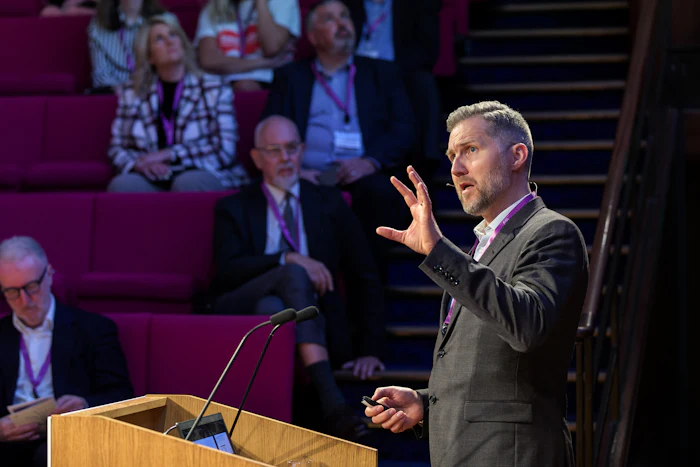
That was the focus of a talk by Professor Jonas Olofsson of Stockholm University and the Karolinska Institute at the International Fragrance Association UK’s (IFRA UK) Fragrance Forum 2026, held October 8 in London.
In his presentation, “The Forgotten Sense of Smell Through Molecules, Models and Our Minds,” Olofsson challenged the historical tendency to regard smell as a primitive sense, overlooked in favor of sight and hearing. His research instead explores how language, thought and other cognitive processes shape the way people perceive odors.
Olofsson and his research team combine behavioral science, neuroscience and language modeling to investigate the relationship between olfaction and cognition. Their work has also identified a new research avenue: using information embedded in online text to better understand how people perceive and describe smells.
The findings have implications beyond fragrance perception. According to Olofsson, understanding olfactory processing could provide valuable insights into the aging mind and brain, including the potential for smell assessments to help detect dementia-related disorders at earlier stages.
The interdisciplinary approach puts olfaction at the intersection of psychology, linguistics and artificial intelligence, opening new possibilities for understanding one of the human senses most often overlooked in cognitive research.
Perfumer & Flavorist+ recently spoke with Olofsson about his talk and the implications of his research.
 "Odors often interact with the receptors in the nasal cavity without resulting in a smell sensation, for example when our attention is directed elsewhere," says Olofsson. "We all have had the experience of entering a new house or apartment, being briefly struck by the new smell before letting it fade out of our consciousness."Teofil Rewers IFRA UK
How much of what we experience as a smell comes from the molecules themselves, and how much comes from the brain interpreting them? What does that mean for how we describe or classify scents?
Olofsson: When asked whether the smell experience is mostly caused by the molecules or the brain interpretation, my response would be "yes."
It is an intricate exchange between bottom-up (sensory) and top-down (cognitive) processes that determine our experiences. But to give a slightly less evasive answer, I believe the interpretation is critical.
Odors often interact with the receptors in the nasal cavity without resulting in a smell sensation, for example when our attention is directed elsewhere. We all have had the experience of entering a new house or apartment, being briefly struck by the new smell before letting it fade out of our consciousness.
Studies have shown that we are often able to recover these ambient smells, which means the phenomenon is not entirely caused by sensory adaptation.
It is also possible to generate olfactory hallucinations, for example temporary events due to physical fatigue or strong expectations, or chronic phantosmia, of which scientists still know little about.
These examples show how much olfaction relies on interpretation. Perfumers and wine experts have a high mental capacity to analyze smells. A significant part of olfactory expertise has to do with a cognitive ability.
How close are we to using smell as a reliable early indicator of cognitive decline, and what would need to happen before these approaches could become part of routine clinical screening?
Olofsson: The research is already at the point where we know how well common odor tests can predict future cognitive decline and dementia. This prediction is as strong as what you get from cognitive assessments or biomarkers in the blood, and when you add olfactory assessments to those more well-established tools, the prediction goes up even more.
In scientific terms, olfaction has "incremental validity" in that it gives added value. But I believe there are three main issues that remain unresolved.
- First, more research is needed to optimize the tests for particular purposes, rather than relying on standard tests. This is what my team is currently working on.
- Second, because olfaction may be affected by so many conditions, like COVID-19, it is important to rule out other causes of smell deficits, for example by means of retrospective self-reports, or even better, implementing universal smell testing throughout life, like we do with eyesight or hearing.
- Third, and perhaps most importantly, there need to be better ways to prevent dementia in high-risk individuals so that early detection is highly prioritized.
When these goals are fulfilled, I am certain olfactory testing will be a routine tool in prediction and prevention of cognitive decline.
Professor Olofsson’s book: The Forgotten Sense: The New Science of Smell and the Extraordinary Power of the Nose