Osmo has opened a new manufacturing facility in Elizabeth, New Jersey, marking a significant expansion of the company’s ambitions to position itself as a vertically integrated fragrance partner powered by artificial intelligence and advanced olfactory technology.
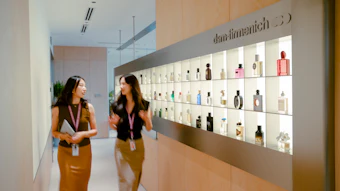
"Osmo's new facility spans 60,000 square feet and brings together everything needed for end-to-end fragrance development and production under a single roof — office, lab and manufacturing," says Osmo's COO, Mateusz Brzuchacz. "That integration is itself a departure from how the industry has traditionally operated, where R&D and manufacturing often live in separate buildings, sometimes in different cities entirely. At Osmo, the people building the AI models, the analytical chemists, and the manufacturing team are all co-located, which means a brief conversation can solve in minutes what would otherwise require days of back-and-forth. The facility is designed to support Osmo's full turnkey offering: fragrance development, manufacturing, bottling, filling, and package design making fragrance accessible to brands that legacy houses have historically turned away."
 "Osmo's new facility spans 60,000 square feet and brings together everything needed for end-to-end fragrance development and production under a single roof — office, lab and manufacturing," says Osmo's COO, Mateusz Brzuchacz. Osmo
The new site will serve both as Osmo’s headquarters and as the primary commercialization hub for its proprietary Olfactory Intelligence platform, an AI-driven system designed to support fragrance formulation, development and manufacturing. The move signals the company’s transition from technology innovator to scaled production partner capable of supporting fragrance creation and fulfillment across the full product lifecycle.
"At a conventional fragrance house, the workflow is largely sequential and human-driven," says Brzuchacz. "A perfumer crafts a formula, it gets handed off to a lab, scaled to production, and quality-checked at the end. AI, if it exists at all, is bolted on as a tool rather than woven into the infrastructure. Osmo's facility was designed to invert that model entirely. The AI is the operating system. Every formula generated by Osmo's Olfactory Intelligence is highly specific and designed to interface directly with the compounding automation. Crucially, the system learns from every single job it produces. That means the models get more accurate, more efficient, and better calibrated to customer needs over time — a compounding advantage that a traditional house running on legacy infrastructure simply can't replicate. Because Osmo is building this from scratch, there's no technical debt, no retrofitting, no workarounds. The entire stack is optimized for AI-native fragrance development from day one."
According to the company, the facility will enable Osmo to provide end-to-end services spanning custom fragrance formulation, manufacturing, bottling and packaging, with a model designed to support both emerging brands and multinational consumer packaged goods companies. The company emphasized that its vertically integrated structure and flexible minimum order quantities are intended to lower barriers to fragrance development while accelerating speed-to-market.
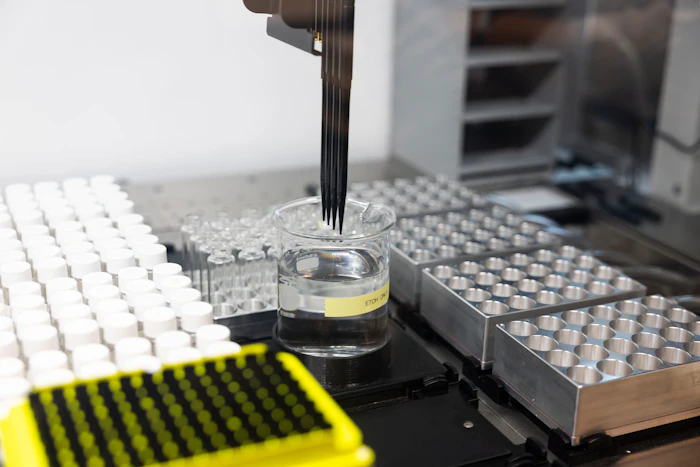
 Osmo’s model combines robotics, fragrance development and machine learning infrastructure within a single operational platform, positioning the company at the intersection of digital olfaction and scalable production.Osmo
"Osmo's default posture is vertical integration," says Brzuchacz. "Fragrance development, manufacturing, bottling, filling and package design are all capabilities Osmo has brought in-house with the deliberate goal being to own the full value chain rather than depend on a patchwork of external vendors. Where external partners come in is strategic: filling gaps, expanding capabilities, or serving specific customer needs that benefit from specialization. On the automation side, the honest answer is that this is a journey. Osmo has made significant investments in automation and is actively working toward a lights-out factory model — but today, humans remain in the loop, and that's by design as much as necessity. The interdisciplinary teams sitting side-by-side: ML engineers, analytical chemists, manufacturing specialists, mean that human intervention is informed, fast, and purposeful. As the models mature and automation deepens, the ratio shifts. The goal is a system where AI runs from brief to formula to production to fulfillment with minimal friction, but the human expertise embedded in the team is what makes that trajectory credible."
Perfumer & Flavorist+ asked Brzuchacz how the company ensures batch-to-batch olfactive consistency when combining AI-generated formulas with automated production.
He noted, "Consistency in fragrance manufacturing is deceptively hard. Raw materials vary by harvest, supplier, and season. Human compounding introduces variability at every step. And the gap between what an AI model generates and what actually ends up in a bottle can widen quickly without rigorous controls. Osmo addresses this at multiple levels. Formulas generated by Olfactory Intelligence are highly specific, not directional sketches, but precise specifications that feed directly into automated compounding equipment capable of dispensing ingredients with extremely high accuracy. That precision is the first line of defense. The second is monitoring. Osmo's QC team tracks both inputs, incoming raw materials, and outputs, finished goods headed to customers in order to catch drift before it becomes a problem. The ambition, consistent with where automation is heading, is to make consistency a property of the manufacturing process itself rather than something that requires constant human verification after the fact. That applies whether the end product is a fine fragrance or a functional application. Osmo is building infrastructure flexible enough to serve both without compromising on either."
And how is Osmo able to pair low minimums and large-scale manufacturing without compromising cost efficiency? Brzuchacz explains: "The fragrance industry has long operated on the tension that high-volume manufacturing requires long runs and standardization, while small-batch or bespoke work requires flexibility and hands-on attention. Most manufacturers pick a lane. Legacy houses have historically set MOQs that effectively price out emerging brands, indie labels, and companies testing new categories, leaving a significant portion of the market underserved. Osmo's answer to this is structural. By integrating AI-generated formulas directly with automated compounding, Osmo can run smaller batches without the per-unit cost penalty that makes low minimums commercially unviable at traditional facilities. The same platform that handles a small run for a boutique brand can scale to support a high-volume customer, because the intelligence and the automation are the same underneath. This is part of what makes Osmo's turnkey offering differentiated. It's not just that minimums are lower, it's that the operational model was designed to make that sustainable at both ends of the volume spectrum."
The opening reflects a broader evolution underway in the fragrance sector, where artificial intelligence is increasingly moving beyond formulation assistance into manufacturing optimization, supply chain coordination and molecule discovery. Osmo’s model combines robotics, fragrance development and machine learning infrastructure within a single operational platform, positioning the company at the intersection of digital olfaction and scalable production.
The facility is designed to support both enterprise-level and emerging customers with differentiated production capabilities. For large multinational partners, the company says it can reduce fragrance costs, shorten development timelines and enable access to proprietary molecules. For smaller brands, the platform offers lower entry thresholds alongside guidance from professional perfumers and integrated production support.
Osmo also noted that the facility will contribute to regional manufacturing activity through partnerships with domestic suppliers specializing in filling, secondary packaging and logistics.
To commemorate the launch, Osmo hosted a ribbon-cutting event attended by New Jersey chief operating officer Kellie Doucette, Elizabeth mayor J. Christian Bollwage and members of the company’s executive leadership team. Demonstrations during the event highlighted how the company’s Olfactory Intelligence platform is applied in fragrance design and production workflows.
The facility opening follows a period of accelerated growth for Osmo. In February, the company announced an expanded executive team and the close of its Series B financing round led by Two Sigma Ventures, bringing total capital raised to $130 million.
For fragrance industry observers, the development represents another sign that AI-enabled olfaction is rapidly shifting from experimental research into commercially scaled infrastructure, with implications not only for formulation workflows, but for how fragrance manufacturing itself may be structured in the years ahead.
Brzuchacz concludes, "The fragrance industry is not short on manufacturing capacity. What it has lacked is a facility built from the ground up with AI and automation as the organizing principles rather than afterthoughts. Most fragrance plants in operation today were designed around human workflows and have been incrementally modernized, a robot here, a software layer there, without fundamentally rethinking the architecture. Osmo's facility represents a purpose-built environment where the AI models, the analytical chemistry, the compounding automation, and the fulfillment infrastructure are vertically integrated and optimized to work together. Every job that runs through the facility makes the models smarter. Every improvement in automation reduces the friction between a formula and a finished product. For brands, this means faster development cycles, more consistent output, and a partner that can grow with them from first sample to full production, all without the MOQ gatekeeping that has defined the industry for decades. That's the gap Osmo is built to close."